


Introduction
When people set out to learn Spanish in the United States, they are often taught a standardized, textbook version of the language that rarely reflects what they hear on the street. With over 40 million Spanish speakers nationwide, the U.S. is home to one of the most dynamic and diverse Spanish-speaking populations in the world.
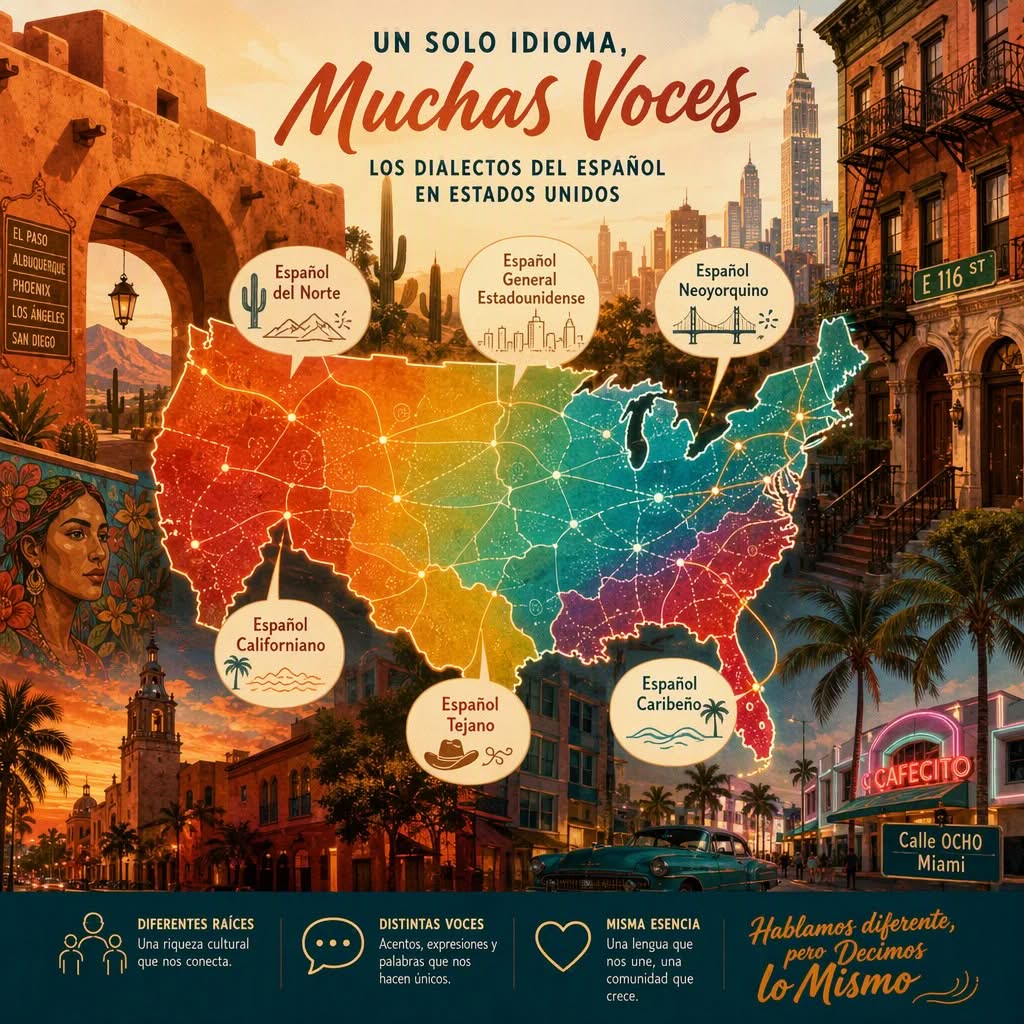
From Mexican Spanish in the Southwest to Puerto Rican and Dominican varieties in the Northeast, the way Spanish is spoken across America is deeply rooted in history, migration patterns, and ongoing daily contact with English.
If you have ever spent years studying textbook Spanish only to feel completely lost during a real-world conversation with a native speaker, you aren't doing anything wrong. The issue is that standard language curricula routinely treat Spanish as a monolithic language, ignoring the rich regional dynamics, distinct phonetic traits, and unique vocabularies that shape how people actually talk.
Understanding these regional varieties is the key to developing authentic listening comprehension, adapting your ear to real-world connected speech, and building genuine fluency.
In this article, we will examine the primary varieties of Spanish spoken across the United States, exploring their historical origins, key linguistic characteristics, and practical strategies you can use to tune your ear to the specific dialect you encounter most.
Historical Origins & Demographic Distribution
Spanish in the United States predates the nation's founding. Long before English became the dominant language of North America, Spanish was established across the continent through early colonial exploration and settlement. Understanding how Spanish evolved in the U.S. requires looking at both its deep historical roots and the distinct migration waves that shaped modern Hispanic communities.
Colonial Foundations and Key Migration Waves
The story of U.S. Spanish begins with centuries of colonial legacy, followed by distinct regional migrations that established localized speech patterns:
The Colonial Legacy: Spanish presence took root in the 16th and 17th centuries, starting with Spanish expeditions in Florida (St. Augustine, founded in 1565) and expanding throughout the American Southwest and Gulf Coast. Communities in northern New Mexico and southern Colorado retain forms of Traditional New Mexican Spanish, a dialect with roots tracing directly back to colonial-era settlers.
Mexican Migration and the Southwest: Following the Treaty of Guadalupe Hidalgo in 1848, tens of thousands of Mexican citizens suddenly found themselves living within newly drawn U.S. borders. Continuous migration throughout the 20th and 21st centuries—driven by agricultural labor demands, economic integration, and shared borderlands, solidified Mexican Spanish as the most widely spoken variety in the country.
Caribbean Waves: Mid-20th-century geopolitical shifts brought massive Caribbean migration to the East Coast. The post-WWII migration wave brought hundreds of thousands of Puerto Ricans to northeastern urban centers. Shortly after, the Cuban Revolution of 1959 established South Florida as a primary refuge for Cuban professionals and families. Subsequent decades saw steady migration from the Dominican Republic, further shaping the phonetic landscape of the Atlantic seaboard.
Central and South American Expansion: Since the 1980s, political instability, economic pressure, and humanitarian crises have led to significant migration from Central America (particularly Guatemala, El Salvador, and Honduras) and South America (including Colombia, Venezuela, and Peru), adding new layers of lexical and grammatical variety to metropolitan areas across the nation.
Geographic Hubs of U.S. Spanish
Because migration occurred in distinct geographic pockets, Spanish in the United States is highly regionalized. Four major hubs define the country’s linguistic landscape:
The Southwest (California, Texas, Arizona, New Mexico): Dominated primarily by Mexican Spanish, this region features strong language continuity across generations. It is characterized by distinct phonetic features, rich borderland slang, and longstanding contact with American English along the border corridors.
Florida (Miami and Tampa): South Florida serves as the epicenter of Cuban Spanish, characterized by rapid cadence, syllable-final aspiration, and unique vocabulary. In recent decades, Miami has transformed into a pan-Latin American hub, integrating sizable populations from Colombia, Venezuela, and Nicaragua.
New York Metropolitan Area: Historically defined by Puerto Rican and Dominican communities, NYC is the focal point of Caribbean Spanish in the U.S. This variety is recognizable by its distinct prosody, dropped consonant endings, and heavy influence on local urban slang and English-Spanish code-switching.
Chicago and the Midwest: As a major industrial and logistics hub, Chicago represents one of the most diverse Spanish-speaking centers in the Midwest. It features a massive Mexican-American majority alongside vibrant Puerto Rican and Central American neighborhoods, creating a dynamic environment where multiple regional dialects interact daily.
Major Regional Varieties in the US
While standard language courses usually treat Spanish as a uniform block, the reality on the ground is something else entirely. Understanding these major varieties, and how they sound in real-world speech, is essential for training your ear to process native speech mechanics accurately.
Mexican Spanish: The Southwest & Midwest Anchor
Representing the majority of Spanish speakers in the U.S., Mexican Spanish provides the foundational cadence for language exposure across the Southwest and major industrial hubs in the Midwest.
Key Linguistic Traits: Highly stable consonant pronunciation paired with shorter, reduced vowel sounds. It features a distinctive rising-and-falling intonation pattern (often described as a melodic "sing-song" cadence) and extensive use of diminutive suffixes (-ito, -ita) to soften requests or express familiarity.
Case Study (Chicago, IL): In neighborhood commercial corridors like Pilsen and Little Village, Mexican Spanish functions as a primary language of daily business. A learner accustomed to textbook Spanish will notice clear, crisp enunciation of consonants like s, d, and t, but may be caught off guard by regional idiomatic expressions ("¿Qué onda?", "padre", "no mames") and frequent incorporation of localized English vocabulary adapted into Spanish syntax.
Caribbean Spanish: Rhythm, Aspiration, and Speed
Prevalent along the Atlantic Seaboard and South Florida, Caribbean Spanish—comprising Puerto Rican, Cuban, and Dominican speech patterns—is famous for its rapid cadence and distinct phonetic reductions.
Key Linguistic Traits: Widespread aspiration or complete dropping of syllable-final s sounds (e.g., los distintos sounds like loh dihtintoh or lo ditinto). You will also hear consonant reduction, where intervocalic d drops out (cansado becomes cansao), along with lambdacism in Puerto Rican Spanish (swapping an r for an l, so puerta becomes puelta) and rotacism in Dominican Spanish (swapping l or r for an i sound in northern regions).
Case Study (The Bronx, NYC): Walking through the South Bronx, you hear a fast-paced blend of Dominican and Puerto Rican Spanish. To an untrained ear, sentences appear to run together with missing consonant endings. However, once you learn the underlying phonetic rules—, uch as listening for vowel lengthening to signal a dropped plural s, your brain adapts, turning what sounded like speed-talking into clear, predictable patterns.
Central & South American Varieties: Metropolitan Diversity
As urban centers across the country attract diverse international populations, Central and South American varieties add further depth to the national linguistic landscape.
Key Linguistic Traits: Central American Spanish (particularly Salvadoran, Honduran, and Guatemalan) frequently features voseo (using vos instead of tú for informal address) and weak syllable-final s pronunciation. South American varieties range from the smooth, sibilant enunciation of Andean regions (Colombia, Ecuador, Peru) to the distinct sheísmo (pronouncing ll and y like the "sh" in "shoe") heard among Argentine and Uruguayan communities.
Case Study (Washington, D.C. Metro Area): Home to one of the largest Salvadoran communities in the nation, the D.C. area offers a clear look at voseo in action. In local markets and community spots, standard informal phrasing like "¿Cómo estás tú?" shifts naturally to "¿Cómo estás vos?", altering verb conjugations in daily conversational flow.
Traditional Heritage Dialects: Historical Linguistic Islands
Beyond recent migration waves, the United States contains isolated, centuries-old Spanish dialects that evolved independently long before modern borders were drawn.
Key Linguistic Traits: Retention of archaic 16th- and 17th-century Spanish vocabulary, unique verb conjugations, and phonetic shifts that have largely disappeared from standard modern Spanish.
New Mexican Traditional Spanish: Preserved in northern New Mexico and southern Colorado, this dialect reflects archaic colonial Spanish mixed with vocabulary borrowed from local indigenous languages (such as Navajo and Pueblo languages) and early American English.
Isleño Spanish (Louisiana): Spoken by descendants of 18th-century settlers from the Canary Islands who settled in St. Bernard Parish, Louisiana. This endangered dialect retains traditional Canary Island phonetics, maritime terminology, and subtle French lexical influences.
Language Contact & Mixed Forms
When two languages exist side by side in daily life, they interact, adapt, and blend. In the United States, language contact between Spanish and English has birthed dynamic, highly structured communication systems that reflect the lived experience of millions of bilingual speakers.
Spanglish & Code-Switching: Rule-Governed Flexibility
Far from being a "sloppy" or incomplete form of either language, code-switching—often referred to broadly as Spanglish—is a sophisticated cognitive and linguistic skill. It requires a deep, intuitive mastery of the grammar of both languages to blend them seamlessly without violating the structural rules of either.
Intra-sentential Switching: Changing languages mid-sentence (e.g., "Voy a llamar a mi hermana because she always knows what to do"). This occurs naturally at specific grammatical boundaries where English and Spanish syntax align.
Inter-sentential Switching: Switching languages between complete sentences or clauses (e.g., "I was going to head out early. Pero al final me quedé trabajando").
Lexical Extensions & Borrowings: Adapting English roots into Spanish verb patterns and nouns. Common examples include lonche (lunch), parquear (to park), troca (truck), and marketeo (marketing). These adaptations allow speakers to navigate dual-language environments with maximum speed and context-specific clarity.
Chicano & Tex-Mex: Phonetic & Lexical Shifts
In regions with generations of deep contact, particularly across California, Texas, and the broader Southwest, bilingual identity has generated distinct regional dialects like Chicano Spanish and Tex-Mex (Tejano Spanish).
Tex-Mex (Tejano Spanish): Centered in South and Central Texas, Tex-Mex incorporates extensive English loanwords, unique idioms, and subtle shift patterns in vowels and stress. Phrases like "Vamos a hacer un cookout" or using English connective words within rapid Spanish conversation are standard markers of local fluency.
Chicano Spanish & Caló: Rooted in Southwestern Mexican-American communities, Chicano Spanish features distinct phonetic shifts (such as shortening or dropping unaccented vowels) alongside Caló—an iconic pachuco slang dialect. Vocabulary includes terms like chante (home), curada (cool/funny), and jale (job/work).
Phonetic Adaptations: Common contact mechanics include softening final consonants, modifying English loanwords to fit Spanish syllabic structures (e.g., chequear for "to check" or mopiar for "to mop"), and shifting stress patterns when navigating back and forth between languages in real time.
Key Linguistic Features Across Varieties
To navigate real-world conversations effortlessly, you need to understand the underlying mechanics that separate standard, written Spanish from spoken regional dialects. When you break these differences down systematically, patterns that previously sounded like random slang or fast talking become predictable linguistic shifts.
Pronunciation and Phonology
How words are pronounced varies dramatically across dialects, primarily driven by how different regions handle specific consonant sounds and syllable structures:
Aspiration and Deletion of /s/: In Caribbean varieties (Puerto Rican, Dominican, Cuban) as well as coastal Central and South American speech, syllable-final s sounds are rarely fully articulated. Instead, they are aspirated into a soft "h" sound (estamos becomes ehtamoh) or dropped entirely (las cosas becomes la cosa). In contrast, Mexican and Andean Spanish keep s sounds exceptionally crisp and sharp.
Consonant Reduction & Intervocalic /d/: In fast, connected speech across Caribbean and lowland dialects, the d sound between vowels often disappears completely. Words like cansado, hablado, and todavía regularly soften to cansao, hablao, and toavía.
Velarization and Phonetic Alternations: In Puerto Rican Spanish, you will frequently encounter lambdacism, where the pre-consonantal or word-final r transforms into an l sound (puerta -> puelta, amor -> amol). In Dominican Spanish, rotacism often shifts the l or r sound into an i sound (pobre -> poibe).
Pronoun Variations: Addressing Your Listener
While textbook Spanish usually limits informal address to tú (and usted for formal contexts), spoken varieties across the U.S. employ a richer range of social dynamics:
Tú vs. Usted: Mexican, Caribbean, and standard Latin American varieties rely heavily on tú for informal address among friends, family, and peers, reserving usted for respect, distance, or formal settings. However, some Central American communities (such as Colombians from specific regions or Costa Ricans) use usted universally, even with close friends or pets.
Voseo: Widespread in Central American varieties (especially Salvadoran, Honduran, and Guatemalan) as well as Argentine Spanish, vos completely replaces or sits alongside tú as the informal second-person pronoun. This shift brings distinct verb conjugations in the present tense, shifting stress to the final syllable (e.g., tú tienes becomes vos tenés, tú hablas becomes vos hablás).
Plural Forms: Across all U.S. Spanish varieties, ustedes is used exclusively for the second-person plural ("you all"), completely replacing the Peninsular Spanish vosotros.
English Borrowings and Lexical Integration
Living in continuous contact with English has created a spectrum of lexical adaptations, ranging from standard loanwords recognized across all Latin America to hyper-local U.S. adaptations:
Direct Phonetic Adaptations: English terms converted directly into Spanish verb and noun mechanics, such as resetear (to reset), textear (to text), scanner -> escáner, or email -> correo electrónico / emilio.
Calques and Semantic Shifts: Translating English concepts literal word-for-word into Spanish using existing vocabulary. For example, using aplicar for a job application (traditionally solicitar), or correr para un cargo for running for office (traditionally postularse).
Spontaneous Loanwords: Dropping English terms directly into Spanish sentences without modification for technical, workplace, or modern cultural concepts where English terms offer immediate efficiency ("Te mando el link por slack", "Hacemos un follow-up mañana").
Sociolinguistic Realities & Media
Language is never just a neutral tool for exchanging information. It is deeply tied to identity, community, and social perception. In the United States, navigating Spanish means operating within a complex sociolinguistic landscape where institutional standard rules constantly interact with real-world, everyday speech patterns.
Identity & Linguistic Pride
For second- and third-generation Latinos, language choice is closely linked to heritage and sense of belonging. However, living between two languages can also create unique pressures:
Linguistic Insecurity: Many heritage speakers who grew up speaking Spanish at home feel self-conscious when encountering formal or textbook Spanish, often viewing their home dialect or code-switching as "imperfect" or "incorrect."
Reclaiming Spanish: Conversely, there is a powerful cultural movement among younger generations to reclaim nonstandard varieties, Tex-Mex, and code-switching as authentic markers of bicultural identity rather than linguistic flaws.
The Dual-Identity Balance: Using regional vocabulary or mixing English and Spanish isn't a sign of language loss. For millions, it is the native dialect of their specific community.
Standard vs. Non-Standard Perceptions
In formal settings, an unspoken hierarchy often privileges certain dialects over others, shaping how speech is perceived in professional and academic environments:
The "Neutral" Ideal: Standard Latin American Spanish, often based on educated urban Mexican or highland South American speech, is frequently treated as the prestige standard.
Stigmatization of Fast & Reduced Speech: Dialects featuring heavy aspiration, dropped consonants, or rapid cadence (like Caribbean Spanish or rural Central American varieties) are sometimes unfairly labeled as "informal" or harder to understand by those accustomed to textbook norms.
Descriptive Reality: From a functional, input-first perspective, no dialect is superior to another. Every regional variety operates on consistent structural mechanics. Understanding these rules strips away artificial stigma and helps you adapt your ear to speech as it is actually spoken.
The Role of U.S. Spanish Media
Media plays a central role in unifying diverse Spanish-speaking populations across the country, serving as both a bridge between dialects and a platform for representation:
Broadcast Media and "Broad Latin American Spanish": Major networks like Univision and Telemundo historically adopted a standardized, phonetically clear broadcast dialect designed to be universally intelligible across all regional backgrounds.
Radio and Localized Content: Regional Mexican radio stations in the Southwest and Midwest, alongside Caribbean-focused broadcasts in New York and Miami, preserve and celebrate hyper-local speech, slang, and musical traditions.
Digital Media & Streaming: Today, podcasts, YouTube creators, and streaming platforms provide direct access to authentic, unscripted regional speech. Learners no longer have to rely solely on polished broadcast news—they can train their ears using natural, conversational audio from virtually any dialect community in the country.

0 comments