


Introduction
If you have ever stared blankly at a conjugation chart while wondering why four years of high school classes left you unable to order a simple coffee in Paris, you are intimately familiar with the textbook plateau. Most language programs trap learners in an endless loop of grammar drills and rote memorization, treating vocabulary like static lists rather than living building blocks.
The real problem is not a lack of innate talent or discipline. It is a system failure. Traditional methods rely on artificial exercises that keep you spinning your wheels, failing to build the intuitive comprehension required for real-world communication.
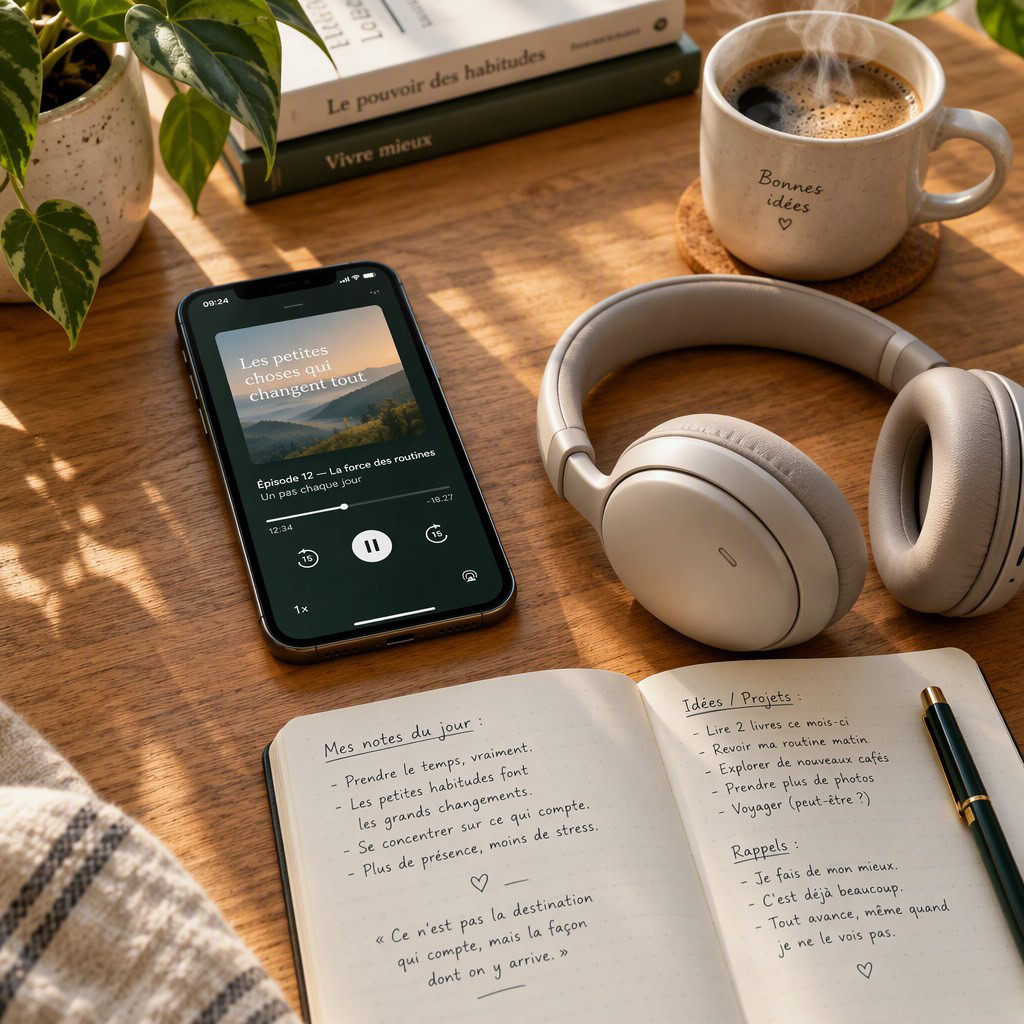
The fastest way to break through this ceiling is through immersive listening. By turning dead time during your daily commutes or neighborhood walks into active input sessions, you flood your mind with natural cadences, idiomatic expressions, and authentic conversational speeds. For intermediate learners at the CEFR A2 to B2 levels, French language learning podcasts serve as the ultimate bridge. Instead of forcing unnatural rules, high-input listening builds the implicit understanding you need to finally cross the chasm from studying French to actually living it.
Why Podcasts Outperform Traditional Study for Intermediate Comprehension
Traditional classrooms love to treat language acquisition like a sterile mathematics problem, forcing you to dissect grammar rules and memorize vocabulary lists out of context. But once you hit the intermediate plateau, that artificial approach completely breaks down.
When you rely solely on textbooks or gamified apps, your brain only learns how to decode written puzzles rather than process living speech. Podcasts bypass this mental bottleneck by forcing your ear to adapt to real-world communication.
Expose yourself to natural cadence, regional accents, and authentic conversational speed. Unlike scripted audio clips designed for absolute beginners, native dialogue features natural liaisons, contractions, and varying tempos that train your auditory processing to handle real French speakers without freezing up.
Build passive-to-active vocabulary acquisition through context rather than rote memorization. Hearing words deployed organically within stories, debates, or cultural discussions lets your subconscious map their exact nuances, transforming passive recognition into active fluency far faster than staring at flashcards ever could.
Top French Podcasts Curated for Intermediate Learners
Before diving into the specific shows, it helps to understand what makes a great intermediate listening resource. When you are stuck at the intermediate level, generic beginner audio feels too slow and frustratingly simplistic, while native media can feel like an overwhelming wall of noise. The following curated list strikes the exact balance you need, by offering content specifically engineered to bridge that gap without sacrificing authenticity.
InnerFrench: The gold standard for A2–B1 learners, Host Hugo Cotton speaks at a slightly reduced speed without sounding childish, tackling deep cultural, psychological, and societal topics with full transcripts.
One Thing In A French Day: Short, bite-sized episodes (around 5–6 minutes) where host Laetitia Perraut shares authentic daily-life stories from Paris, perfect for B1–B2 learners looking for quick daily reps.
Journal en français facile (RFI): Ideal for moving toward advanced content. 10 minutes of real international news spoken at a deliberate, clear journalistic pace with accessible vocabulary and official transcripts.
Passerelles: Created specifically for intermediate learners by a FLE (Français Langue Étrangère) teacher, exploring varied themes to help build confidence and natural listening habits.
How to Practice with Podcasts
Simply downloading a playlist of French podcasts and pressing play in the background will not automatically turn you into a fluent speaker. If you want to break past your limits, you need an intentional, structured approach that transforms passive listening into active skill-building.
The 2-Pass Method: Listen to an episode twice with a specific strategy. Your first pass focuses purely on capturing the general gist and tuning your ear to the rhythm of the language without looking at any aids. Your second pass involves listening while reading along with the transcript for deep analysis, unpacking unfamiliar structures, and cementing comprehension.
Active Shadowing: Stop treating audio as a spectator sport. Pause the recording periodically and repeat sentences aloud, matching the speaker cadence as closely as possible to lock in natural rhythm, intonation, and pronunciation.
Vocabulary Capture: Instead of mindlessly memorizing isolated word lists, extract useful chunks and phrases directly from the context of the dialogue. Reviewing these phrases inside their original sentences ensures your brain understands how they actually function in conversational French.
Pitfalls to Avoid & How to Combine Audio with Other Tools
Avoid passive background listening without mental engagement or regular review. Treating foreign audio like white noise while driving or working out accomplishes very little if your brain is not actively parsing the syntax and vocabulary.
Pair podcast input with active output (like speaking drills or structured writing exercises) to close the loop. Listening builds your comprehension foundation, but true fluency requires bridging that input directly to active production. This is precisely why combining immersive audio with a structured platform like LingoGym accelerates your progress, turning raw listening comprehension into automatic, zero-pause speech through its active training circuit.

0 comments