


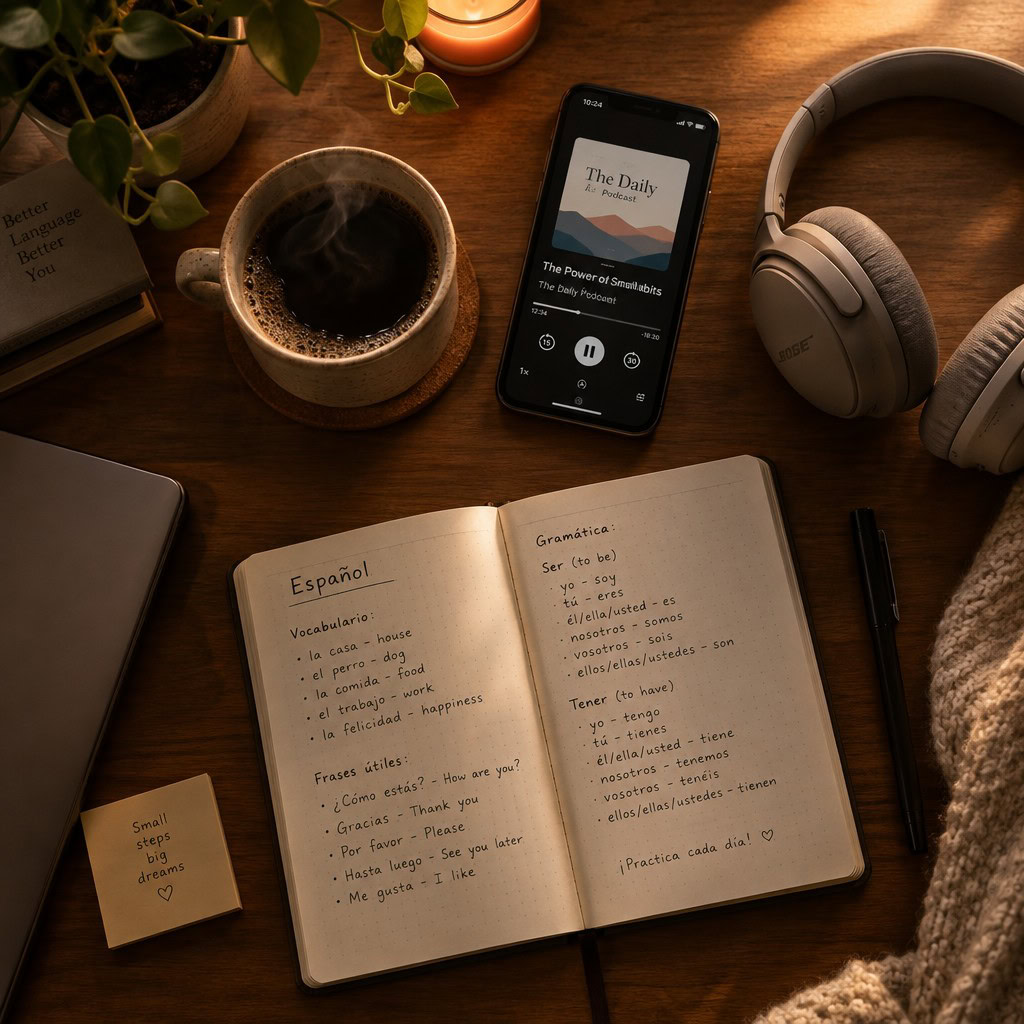
If you’ve spent any time trying to master Spanish through traditional apps or high school grammar drills, you already know how it ends. You memorize conjugation charts, grind out robotic flashcards, and walk away feeling like you’re fluent in theory, until a native speaker actually talks to you. Suddenly, you're stuck in the silent restaurant: paralyzed, overthinking every tense, and unable to string a natural sentence together.
The missing link isn't more discipline or another gamified app designed to keep you tapping buttons. It’s input.
If you want to build an intuitive, automatic understanding of Spanish, you need to flood your ears with massive amounts of real, contextual audio. That’s where Spanish language learning podcasts change the game. Instead of treating a language like a math problem to solve, podcasts allow you to absorb the natural rhythm, intonation, and vocabulary of the language while you're commuting, walking your neighborhood, or doing chores.
In this comprehensive guide, we are going to break down everything you need to build a high-leverage listening routine. We’ll cover:
The structural benefits of why listening-first approaches beat traditional memorization.
How to choose the right shows based on your exact current level, whether you're starting from scratch or refining an intermediate ear.
Top-tier podcast recommendations categorized so you never waste time guessing what to listen to next.
Actionable daily frameworks for turning passive listening into active, long-term fluency without burning out.
Let’s dive in and fix your listening routine for good.
Why Use Podcasts to Learn Spanish?
If your only exposure to Spanish has been through high school grammar drills or tapping buttons on a gamified app, you’ve been treating language acquisition like a math problem. You’re trying to consciously calculate rules, conjugations, and sentence structures in real time.
That is not how humans learn languages.
To achieve true fluency, you need to build an intuitive, automatic ear. That’s why regular listening to Spanish podcasts is essential if you want to make serious progress.
1. Flood Your Mind with Massive Input
Language acquisition happens when you consume massive amounts of comprehensible input. Podcasts allow you to flood your ears with natural, contextual Spanish without the friction of reading text or staring at a screen. Over time, your brain begins to recognize patterns, pacing, and vocabulary organically, shifting your knowledge from conscious effort to subconscious fluency.
2. Take Advantage of Dead Time
The classic excuse of "I don't have time" is a myth when it comes to audio learning. Podcasts unlock the hidden margins of your day. You can plug in your headphones and absorb native audio during your daily neighborhood walks, your morning commute, or while knocking out chores around the house. You aren't squeezing an extra hour into a packed schedule. You're simply layering language acquisition on top of the routines you already maintain.
3. Build a Multi-Tool Arsenal
Podcasts aren't meant to be your only tool. Relying on a single app or medium is a rookie mistake. Instead, podcasts act as the ultimate bridge between passive exposure and active output. They complement your reading habits, flashcard reviews, and speaking sessions by giving you a realistic benchmark of how native speakers actually pace and structure their thoughts.
How to Choose a Spanish Learning Podcast
Finding the right podcast isn’t about picking the most popular show on the charts or the one with the flashiest marketing. It’s about matching the audio feed to your current capabilities so you don’t crash against a wall of frustration.
When you're building your listening routine, run your options through these four criteria:
Assess Your Current Level: Be brutally honest about where you stand. If you're starting from scratch, jumping straight into rapid, native-speed talk radio is a recipe for disaster. On the flip side, if you're intermediate, beginner shows will bore you to tears. Pick a show that stretches your comprehension without completely locking you out.
Audit the Audio Quality and Delivery: Look for crisp audio, a manageable speaking pace, and topics that actually hold your interest. If the host's voice grates on you or the recording sounds like it was done in a wind tunnel, you won't stick with it. Consistency relies on friction-free habits.
Check for Transcripts and Learning Aids: Look for shows that provide transcripts, translations, or vocabulary breakdowns. You don't need to read every word, but having a safety net for unfamiliar phrases prevents you from guessing blindly.
Match the Format to Your Learning Style: Decide what style keeps you engaged. Do you prefer structured instructional lessons that break down grammar and phrasing, unscripted conversational chats between native speakers, immersive story-driven audio dramas, or real-world cultural and news deep dives?
Best Spanish Language Learning Podcasts by Level
To make serious progress, you need content that matches your current listening comprehension.
Here are a few recommendations broken down by proficiency level to help you build your routine:
Podcasts for Beginners
Look for slow, clearly spoken Spanish and explanations in English to help bridge the initial gap without overwhelming your ear.
Prioritize everyday phrases, essential grammar, and practical vocabulary.
Coffee Break Spanish: An exceptional, structured audio course that takes you from absolute basics to advanced conversations with patient, manageable pacing.
News in Slow Spanish: Delivers current events and world news at a measured, deliberate speed so you can build comprehension of real-world topics without getting lost.
SpanishPod101: Features an extensive library of short, practical audio and video lessons covering a massive range of everyday scenarios and native dialects.
Podcasts for Intermediate Learners
Choose shows that mix natural Spanish conversation with occasional contextual explanations.
Explore topics that build listening confidence, introduce idiomatic expressions, and push past the typical intermediate plateau.
StoryLearning Spanish: Follows engaging, serialized short stories designed specifically for intermediate learners, complete with built-in vocabulary cues at the end of each episode.
Notes in Spanish: Features unscripted, natural conversations between a native speaker and a non-native partner tackling real-world topics beyond basic textbook phrases.
Spanish Obsessed: Offers relaxed, organic dialogues recorded by a native-non-native couple, making it ideal for picking up conversational rhythms and everyday phrasing.
Podcasts for Advanced Learners
Try natural-speed conversations, interviews, journalism, and cultural storytelling entirely in Spanish.
Use complex syntax, nuanced humor, and diverse regional accents to bulletproof your listening comprehension.
Radio Ambulante: Often described as the This American Life of the Spanish-speaking world, this NPR-distributed podcast features rich, gripping narrative journalism from across Latin America.
No Hay Tos: Hosted by native Mexican Spanish speakers who tackle raw, unscripted cultural discussions, idioms, slang, and societal topics at native speed without slowing down or filtering for learners.
Españolistos: Hosted entirely in Spanish, featuring deep dives into culture, education, and controversial topics designed to rapidly expand your active vocabulary.
Types of Spanish Podcasts to Explore
Not all podcasts are created equal, and relying on just one style will leave gaps in your comprehension. To build a well-rounded ear, you want to mix and match different formats depending on your goals and energy levels:
Structured Language Lessons: These shows focus explicitly on grammar, vocabulary breakdowns, and targeted explanations. They are ideal when you want to understand the why behind a structure without staring at a textbook.
Conversational Podcasts: Featuring unscripted or semi-scripted dialogues between native speakers, these shows give you a front-row seat to authentic rhythms, colloquial expressions, and natural conversational flow.
Stories and Audio Dramas: Perfect for intermediate learners, narrative-driven shows allow you to absorb vocabulary entirely through context. When you're hooked on a story line, memorizing words stops feeling like a chore.
Culture, Travel, and News Shows: Designed for deep immersion, these real-world podcasts cover current events, history, and cultural deep dives. They force you to process Spanish at native speeds and connect you directly to the pulse of the Spanish-speaking world.
How to Learn Spanish with Podcasts
Pods aren’t background noise to wash dishes to while your brain stays completely switched off. If you want actual fluency, you have to treat audio as an active input stream.
Here is how to structure your listening sessions for maximum retention:
Listen Once for the Big Picture, Again for the Details: On your first pass through an episode, focus purely on the overall narrative or context. Don't panic over words you miss. On your second listen, zero in on specific phrases, intonation patterns, and vocabulary you didn't quite catch the first time.
Use Transcripts as a Safety Net, Not a Crutch: Real listening means training your ear to process foreign sounds without reading along. Use transcripts to check your comprehension or decode tricky phrases after you've listened, rather than staring at the text the entire time.
Capture High-Value Vocabulary: When a phrase or idiom repeats itself naturally, pull it out and drop it into your flashcard deck or notebook. Don't try to catalog every single unknown word—focus only on high-frequency terms you'll actually encounter in the wild.
Pause and Repeat Aloud: Language acquisition requires muscle memory. When a host or speaker drops an interesting sentence, hit pause, mimic their exact rhythm, and say it out loud. This bridges the gap between passive listening and active speaking output.
Lock in a Consistent Routine: Consistency always beats volume. Committing to a 15-minute daily listening habit during your neighborhood walk or commute will put you miles ahead of someone who crams an hour of audio once a week.

0 comments