


Introduction & Quick Overview
When most people think about constructed languages (conlangs), they imagine fictional tongues like Klingon or High Valyrian. But in the real world, conlangs serve a very real, practical purpose.
For some languages, it's about breaking down international communication barriers. For others, it's about completely rewiring how you process your daily thoughts.
Constructed languages offer a shortcut to language learning that natural languages simply cannot match. 2 of the most popular and influential conlangs in existence today are Esperanto and Toki Pona.
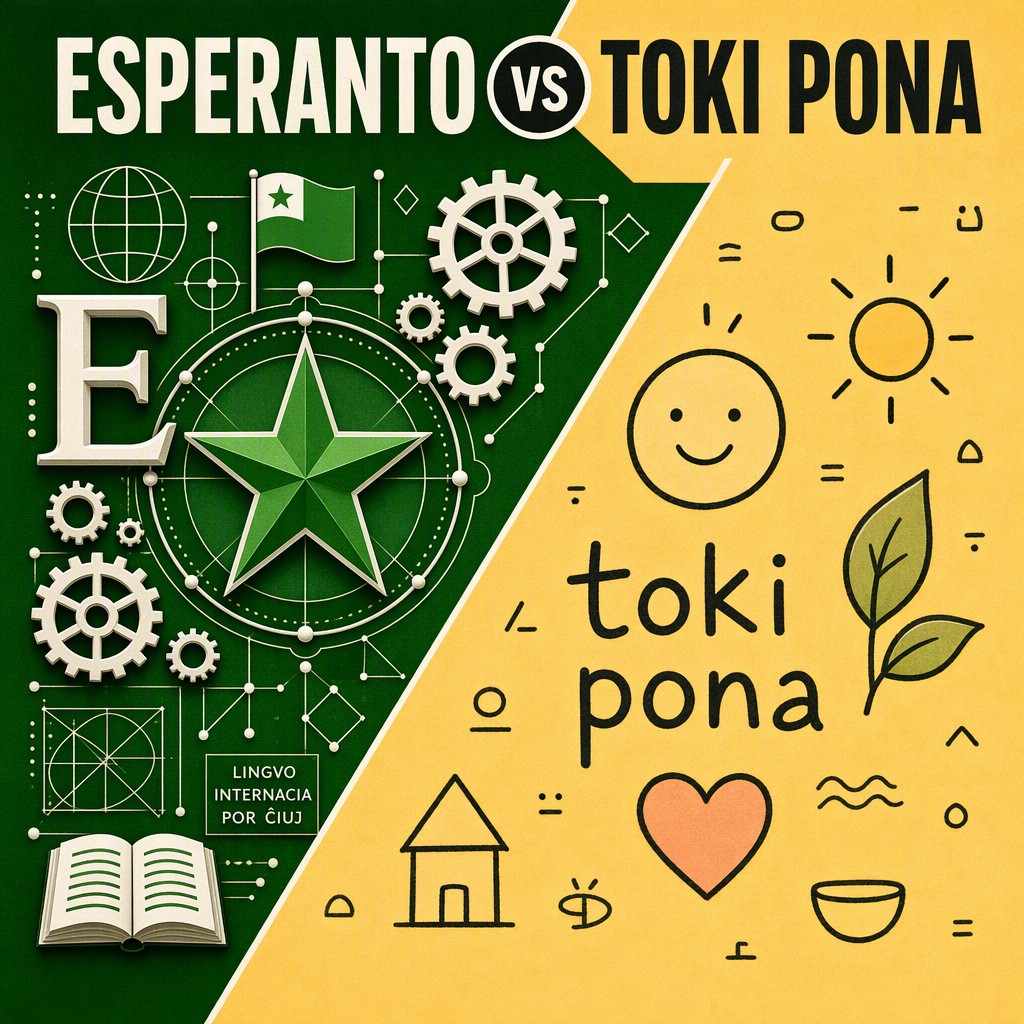
While both were created to solve specific problems with human speech, they approach the challenge from completely opposite ends of the spectrum. Esperanto was built to be a full-scale international auxiliary language that lets anyone express complex ideas with total precision. Toki Pona, on the other hand, is a philosophical exercise in extreme minimalism, designed to simplify life down to its absolute core concepts.
Here is a quick snapshot of how these 2 constructed languages stack up against each other:
- Primary Philosophy: Esperanto aims for international neutrality and effortless global communication. Toki Pona aims for mindfulness, cognitive simplicity, and Zen-like clarity.
- Vocabulary Size: Esperanto features thousands of root words combined with a regular system of affixes to build an infinite vocabulary. Toki Pona relies on only 120 to 137 essential core words.
- Grammar & Rules: Esperanto has 16 basic grammar rules with few exceptions, designed for complete expressive precision. Toki Pona uses a hyper-simple grammar system focused on context and minimalism.
- Estimated Time to Basic Fluency: Esperanto takes roughly 12 months of consistent input and output. Toki Pona takes about 30 hours to start having basic conversations.
- Global Community: Esperanto boasts around 2 million speakers, active global congresses, literary works, and vibrant digital hubs. Toki Pona features a rapidly growing, highly creative online community centered around social media and chat servers.
Choosing which conlang deserves your time comes down to what you want from your language-learning journey: a functional bridge to world culture or an intellectual reset.
Origins, Philosophy, and Design Goals
To truly understand the difference between Esperanto and Toki Pona, you have to look at why they were created in the first place. Their design goals stem from completely different worldviews, created over a century apart.
Esperanto was created in 1887 by L.L. Zamenhof, an eye doctor raised in Bialystok, a city torn by ethnic and linguistic division. Zamenhof believed that a neutral, easy-to-learn second language could eliminate misunderstandings and foster world peace. His goal was ambitious: build a full-scale international auxiliary language meant for global trade, diplomacy, literature, and everyday life. Esperanto was designed to sit alongside everyone's native language, leveling the playing field so no single nation held linguistic dominance.
Toki Pona took a radically different path. Created in 2001 by Canadian linguist Sonja Lang, Toki Pona was never intended to be a global trade language or a diplomatic tool. Lang designed it as a personal mental tool during a period of depression. Influenced by Taoist philosophy, Toki Pona is an exercise in extreme minimalism, designed to simplify thought processes and promote mindfulness. Instead of attempting to express every complex technical nuance, Toki Pona forces the speaker to break big ideas down into basic, essential concepts, acting almost as a form of meditation through speech.
In short: Zamenhof built a bridge to connect the entire world through expressive precision, while Lang built a lens to clear the mind through radical simplicity.
Linguistic Breakdown: Grammar, Vocabulary, & Script
The mechanical contrast between Esperanto and Toki Pona highlights two entirely different approaches to language construction. One relies on systematic agglutination to build precise vocabulary, while the other strips language down to an elemental set of semantic building blocks.
Vocabulary & Word Building
Esperanto uses a highly modular affix system built on top of a core of international roots (mostly Latinate and Germanic). By adding specific prefixes and suffixes to a root word, you can instantly alter its meaning or change its part of speech with mathematical consistency. For instance, starting with the root san- (health):
- Sana = healthy (adjective)
- Malsana = sick (mal- indicates the direct opposite)
- Malsanulejo = hospital (-ul- means person, -ej- means place, -o means noun or physical object)
Toki Pona discards affixation and large root vocabularies entirely, functioning with a fixed set of roughly 120 to 137 core words. Instead of creating single specific words for complex items, Toki Pona relies on noun-modifier compounds. Because there is no single word for "hospital," a Toki Pona speaker describes the concept based on its essential qualities in context: tomo pi pona sijelo (building of body wellness/hospital), tomo sona (knowledge room/schoolhouse) or tomo telo (water room/bathroom).
Grammar & Phonetics
Both languages feature highly regular, phonetic spelling systems where every letter maps to a single sound.
Esperanto's grammar relies on 16 fundamental rules with few exceptions. Distinct word endings mark parts of speech: nouns end in -o, adjectives in -a, adverbs in -e, and verbs in specific tense markers like -as (present) or -is (past). It also utilizes an accusative case ending (-n) to mark direct objects, which allows for flexible word order without losing clarity.
Toki Pona features an ultra-simple grammar structure governed by context separators. It uses particle words like li (separates subject and verb), e (marks the direct object), and la (sets context or condition). Word order is strictly Subject-Verb-Object, and words do not change form based on tense, pluralization, or part of speech. Tense and nuance are inferred purely from context.
Parallel Example Comparison
To see the philosophical and structural difference in action, observe how both languages translate a simple concept: "The good friend gives me fresh water."
- Esperanto:
La bona amiko donas al mi freŝan akvon.
- Breakdown: La (the) bon-a (good-adj) amik-o (friend-noun) don-as (give-present) al mi (to me) freŝ-a-n (fresh-adj-accusative) akv-o-n (water-noun-accusative).
- Note: Notice the absolute precision. Every grammatical role is explicitly tagged.
- Toki Pona:
jan pona mi li pana e telo lete tawa mi.
- Breakdown: jan pona (good person/friend) mi (my) li [verb separator] pana (give/emit) e [object separator] telo lete (cold/fresh liquid) tawa mi (towards me).
- Note: Notice how "friend" becomes "good person" and "fresh water" becomes "cold liquid," forcing the speaker to describe the physical reality of the objects.
Learning Curve & Real-World Community
The path to mastery and the real-world ecosystem for these two conlangs could not be more different. One feels like learning a highly regular European language, while the other feels like learning a minimalist game of mental chess.
Time to Fluency
- Esperanto: Because Esperanto shares significant vocabulary roots with major European languages and features zero irregular rules, native English speakers can usually reach conversational fluency (B1/B2 level) within 6 to 12 months of dedicated, daily input and output. Compare that to the 1,000+ hours typically required for a natural language like Spanish or French, and Esperanto proves to be one of the most time-efficient language investments available.
- Toki Pona: You can memorize Toki Pona's entire vocabulary of roughly 120 words in a single weekend. Understanding the core grammar mechanics takes just a few hours. However, developing the mental speed to combine those basic concepts into fluid, real-time conversations usually takes around 4 to 6 weeks of consistent practice.
Communities & Major Events
- Esperanto's Global Network: Esperanto boasts a century-old, real-world cultural infrastructure. The flagship event is the annual Universala Kongreso (World Esperanto Congress), which attracts hundreds to thousands of attendees from over 60 countries every year for a week of lectures, theater, and concerts conducted strictly in Esperanto. Beyond global congresses, there are local clubs, music acts, original literature, and home-stay networks like Pasporta Servo that allow Esperantists to travel the world and stay with local speakers for free.
- Toki Pona's Digital Renaissance: Toki Pona does not have a physical homeland or traditional worldwide congresses, but it thrives in high-density digital spaces. Its community is younger, hyper-creative, and primarily hosted across massive Discord servers (such as ma pona pi toki pona), Reddit (
r/tokipona), Telegram, and VR Chat. The language is used heavily for creative writing, zines, micro-blogging, and original art.
Recommended Learning Resources
- Esperanto:
- Duolingo: Great for building basic vocabulary and sentence pattern recognition early on.
- Lernu.net: A free, comprehensive online course featuring interactive lessons, grammar guides, and community forums.
- Complete Esperanto (Teach Yourself series): Ideal for learners who prefer a structured, book-based approach to grammar and readings.
- Toki Pona:
- Toki Pona: The Language of Good (Official Book by Sonja Lang): The definitive guide written by the language's creator.
- 12 Days of Toki Pona (YouTube by jan Misali): A popular video series that breaks down the vocabulary and grammar rules step by step.
- lipu sona pona: A widely used online course and interactive cheat sheet for quick reference.
Pros, Cons, & Direct Comparison
Choosing between Esperanto and Toki Pona isn't about deciding which language is objectively "better." It comes down to whether you want a comprehensive communication system or a minimalist cognitive framework.
Esperanto: Pros & Cons
Pros:
- Expressive Precision: You can express complex, nuanced technical, philosophical, or literary concepts with complete exactness.
- Vibrant Real-World Culture: Access to original literature, magazines, music, active local clubs, and global congresses with over a century of history.
- Strategic Bridge Language: Learning Esperanto builds pattern recognition and grammatical intuition, making it significantly easier to pick up other languages later, especially Romance languages.
Cons:
- Longer Commitment: While fast compared to natural languages, it still requires months of steady, daily input and output to reach high-level fluency.
- Eurocentric Bias: Its vocabulary roots and structure lean heavily European, which means it isn't completely neutral for speakers from non-Western backgrounds.
Toki Pona: Pros & Cons
Pros:
- Rapid Mastery: You can comfortably learn the entire core vocabulary and grammar in a weekend.
- Mental Reset & Mindfulness: Forces you to stop relying on jargon or complex buzzwords, compelling you to break down big thoughts into simple, honest truths.
- Creative Playground: A tight-knit, innovative digital community focused on art, poetry, and creative problem-solving.
Cons:
- Heavy Context Reliance: Because a single phrase can mean dozens of different things, misinterpretation is common without clear shared context.
- Practical Limitations: You cannot efficiently write a technical manual, precise legal document, or detailed medical report in Toki Pona.
Direct Comparison
| Feature | Esperanto | Toki Pona |
| Core Goal | Universal international communication | Philosophical minimalism & mindfulness |
| Vocabulary | Thousands of roots and affixes | ~120 to 137 Words |
| Precision | Very high | Low, dependent on context |
| Learning Time | ~600 Hours | ~10 hours for basic conversational fluency |
| Best use-cases | Travel, literature, international friendship | Journaling, mental clarity, linguistic fun |
Choosing between Esperanto and Toki Pona isn't about deciding which language is objectively "better." It comes down to whether you want a comprehensive communication system or a minimalist cognitive framework.
Which Conlang Should You Learn?
Deciding between Esperanto and Toki Pona comes down to what you want your language journey to look like. Both constructed languages offer massive cognitive benefits, but they serve completely different ambitions.
Quick Decision Guide
Choose Esperanto if:
- You want a gateway to natural languages: Esperanto acts as a powerful bridge language, helping you build core grammar intuition and pattern recognition that makes learning Romance languages like Spanish, French, or Italian much faster later on.
- You value international community and travel: You want to attend global events, read original books and magazines, listen to music, or take advantage of homestay networks like Pasporta Servo.
- You want complete expressive precision: You need a language where you can debate complex topics, write detailed articles, or share nuanced thoughts without running into vocabulary bottlenecks.
Choose Toki Pona if:
- You want immediate results: You want to learn an entire functioning language in a weekend or two without sinking months into study routines.
- You are seeking mental clarity and mindfulness: You want an intellectual exercise that forces you to strip away jargon, slow down your thoughts, and focus on basic, elemental concepts.
- You love creative constraints: You enjoy creative writing, poetry, or casual chat in tightly-knit digital communities that thrive on context and puzzle-like communication.

0 comments