


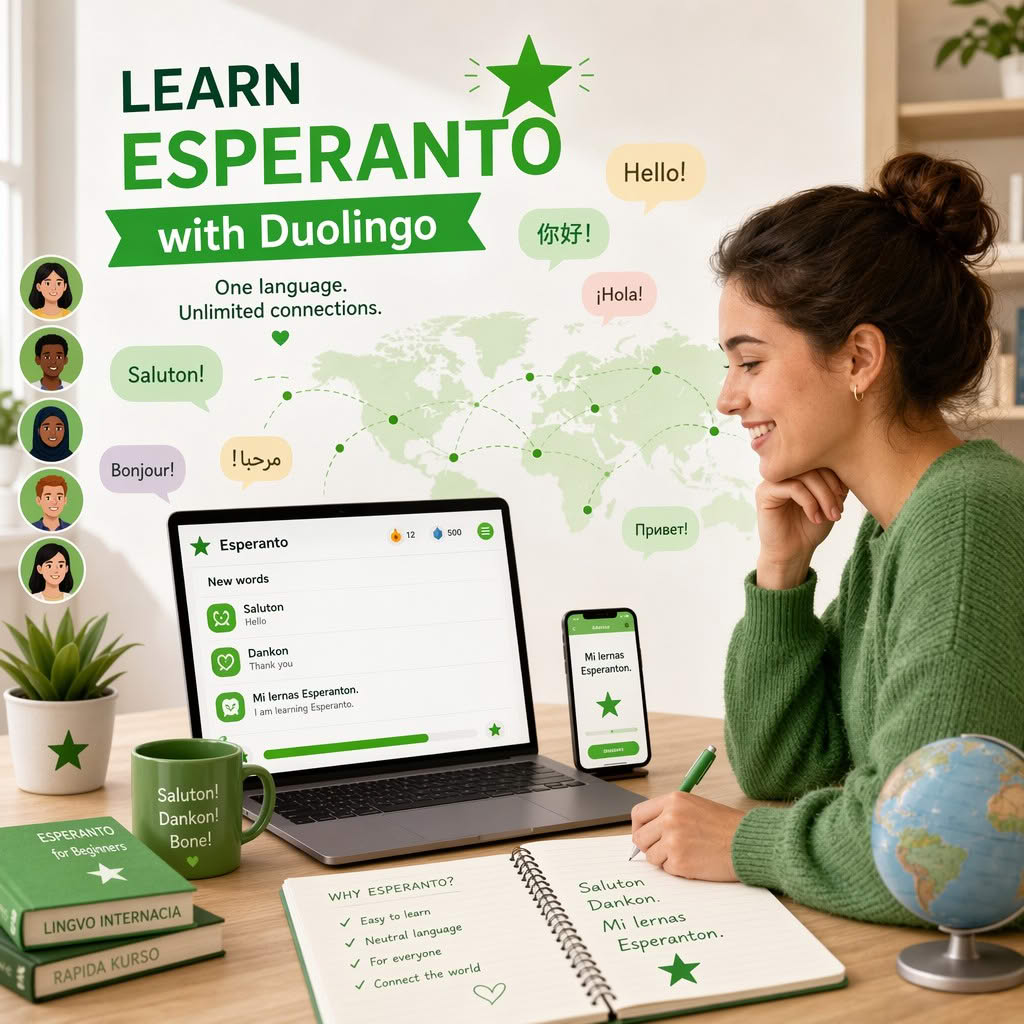
Introduction — Answering the Question Up Front
Yes, you can learn Esperanto on Duolingo, especially if you’re a complete beginner and want an easy way to get started with the language.
Duolingo’s Esperanto course can help you build a foundation in basic vocabulary, sentence structure, and grammar. It’s simple, accessible, and beginner-friendly, which makes it a solid first step for anyone curious about Esperanto.
That said, Duolingo should not be the only tool you use if your goal is to actually speak and understand Esperanto comfortably. Like with any language, relying on a single app is one of the easiest ways to stall your progress. Duolingo can introduce you to the language, but you’ll eventually need more input, more listening, more reading, and ideally some real interaction with other Esperanto speakers.
In this post, we’ll look at what the Esperanto course on Duolingo offers, where it shines, where it falls short, and how to use it as part of a smarter language learning routine.
This question matters because Duolingo is one of the most popular language learning apps in the world, and Esperanto continues to attract beginners, polyglots, and language hobbyists who are interested in learning a logical, international language with a global community behind it.
What Is Esperanto? Quick Background
Esperanto is the world’s most successful constructed language. It was created in the late 1800s by L. L. Zamenhof with the goal of giving people from different countries and cultures a neutral, easy-to-learn language they could use to communicate with each other.
Unlike natural languages, Esperanto was designed to be as regular and straightforward as possible. The spelling is phonetic, which means words are generally pronounced the way they are written. The grammar is highly consistent, so you do not have to deal with the same level of irregular verbs, random exceptions, or confusing spelling patterns that you find in languages like English, French, or Spanish.
A lot of Esperanto vocabulary comes from European languages, especially Romance and Germanic languages, which can make many words feel familiar if you already speak English. For example, words like bona for “good,” granda for “big,” and rapida for “fast” are not too hard to recognize once you start seeing them in context.
People learn Esperanto for different reasons. Some want to have conversations with Esperantists from around the world. Some want to read Esperanto literature, listen to podcasts, watch videos, or attend online and in-person events. Others use Esperanto as a stepping stone into learning additional languages.
This is one of the reasons Esperanto has a reputation for being easier to learn than many other languages. It removes a lot of the unnecessary friction that slows beginners down, which means you can often start understanding and using the language much sooner than you might expect.
Duolingo's Esperanto Course — Overview
Duolingo introduced its Esperanto course for English speakers in 2015, giving beginners a simple and accessible way to start learning the language for free. Like many Duolingo courses, it was developed with the help of contributors who were familiar with the language and wanted to make Esperanto more available to a wider audience.
The course follows Duolingo’s standard learning path. Instead of handing you a grammar textbook, it breaks the language into small lessons that gradually introduce vocabulary, sentence patterns, and basic grammar. You move through short exercises, complete units, and build your Duolingo Score as you progress. At the time of writing, the Esperanto course can take you up to a Duolingo Score of 30, which is roughly around an A2 level. In other words, it can help you become a strong beginner, but it will not make you fully fluent by itself.
The exercises include a mix of reading, listening, translation, word matching, and typing. You might translate Esperanto sentences into English, build Esperanto sentences from word tiles, listen to audio and choose the correct answer, or type out a sentence yourself. This variety makes the course feel approachable, especially if you are new to language learning.
Strengths of Learning Esperanto on Duolingo
One of the biggest strengths of learning Esperanto on Duolingo is accessibility. You can start for free, create an account in a few minutes, and begin working through lessons without needing to buy a textbook or understand a complicated study system. For a beginner who is simply curious about Esperanto, that low barrier to entry is a huge advantage.
Duolingo also does a good job of encouraging consistency. The app uses streaks, reminders, daily goals, and progress indicators to keep you coming back. And in language learning, consistency matters a lot. A few minutes of Esperanto practice every day is far better than studying for two hours once and then disappearing for three weeks.
The Esperanto course also gives you a decent foundation in the language. You’ll be introduced to common vocabulary, basic sentence structures, regular grammar patterns, and everyday phrases. Since Esperanto is already more regular than many natural languages, this can make the early stages feel surprisingly smooth. You start noticing patterns quickly, which can be very motivating.
Another strength is the bite-sized format. Duolingo lessons are short, simple, and easy to fit into your day. You can complete a lesson while waiting in line, during a lunch break, or before going to bed. The immediate feedback also helps because you know right away whether you got something correct or need to try again.
The gamified elements can also be helpful, especially in the beginning. Badges, XP, levels, and streaks might not make you fluent, but they can make the process feel more fun. And when you’re building a new language habit, anything that helps you show up consistently can be useful.
Duolingo has also had community features that made the learning experience more engaging, including user discussions, tips, and events. Some of these features have changed over time, so availability may depend on the current version of Duolingo you’re using. Still, the broader point remains: learning Esperanto becomes more powerful when you connect with other learners and speakers instead of studying alone forever.
Limitations of Duolingo for Esperanto
Duolingo is a useful starting point for Esperanto, but it has some clear limitations.
The first major issue is depth. Duolingo can expose you to Esperanto grammar, but the actual grammar explanations are virtually nonexistent. This can be frustrating because Esperanto is a very logical language, and a simple explanation of how word endings, correlatives, or affixes work can save you a lot of confusion. Instead, Duolingo often expects you to figure out patterns through repetition.
Another limitation is speaking practice. At least for the Esperanto course, there are no speaking exercises available. This means you can complete lessons, recognize words, and translate sentences without ever training yourself to pronounce Esperanto out loud or hold a conversation. That’s a problem if your goal is to actually speak the language with other Esperantists.
Duolingo also does not give you much authentic context. You are mostly working with isolated sentences rather than real articles, videos, podcasts, conversations, or literature. Those things matter because languages are not just collections of words and grammar rules. You need to see how the language is used naturally by real people in real situations.
There is also the risk of becoming a passive learner. Duolingo often trains recognition more than production. You might get good at choosing the right answer from a list or translating a short sentence, but that does not automatically mean you can express your own thoughts in Esperanto. Understanding and producing a language are related, but they are not the same skill.
This is where many learners hit a plateau. Duolingo can help you reach the beginner stage, but if you want to move beyond that, you will need external materials. That could include Esperanto podcasts, YouTube channels, books, online communities, language exchanges, or tools like Anki and Clozemaster. In other words, Duolingo can open the door, but it should not be treated as the whole house.
How to Use Duolingo Effectively to Learn Esperanto
The best way to use Duolingo to learn Esperanto is to treat it as your core daily practice, not your entire learning system. Set a realistic goal you can actually maintain, even if that is only 10 to 15 minutes per day. The point is to build consistency. If Duolingo helps you show up every day and stay connected to Esperanto, then it is doing something valuable.
That said, you should not only tap through lessons silently. Pair Duolingo with active production. After each lesson, try writing a few short sentences using the words and structures you just learned. You can also read sentences out loud, repeat the audio, and practice forming your own examples. Even if your sentences are simple, this helps you move from passive recognition to actual use.
I would also recommend using Lernu.net alongside Duolingo. Lernu is much more fleshed out as an Esperanto learning resource, and it includes clearer grammar explanations than Duolingo. This is especially useful when you run into parts of Espereranto that are easy in theory but confusing at first, such as the accusative ending, correlatives, prefixes, suffixes, and word order.
If Duolingo has notes or tips available for the Esperanto course, use them. But when something still does not make sense, do not just guess forever. Look it up in an external grammar reference, such as the Lernu grammar section. Esperanto is a very regular language, so once someone explains the pattern clearly, it usually becomes much easier to recognize and use.
You can also make your learning more social. The unofficial Duolingo subreddit and Esperanto Discord servers can be useful places to ask questions, find other learners, and get practice partners. This matters because Esperanto was created for communication. At some point, you want to move beyond exercises and start interacting with real people.
Finally, track your progress with a simple study log. Write down what you practiced, how long you studied, and which areas still feel weak. Every week or two, review the skills that gave you trouble instead of only pushing forward. This keeps your Esperanto learning more intentional and helps you avoid the common trap of completing lessons without actually retaining much.
Best Supplementary Resources to Pair with Duolingo
If you want to learn Esperanto seriously, Duolingo works best when you pair it with other resources. Duolingo can give you daily practice and basic exposure, but supplementary materials will help you understand the language more deeply and actually use it in real life.
For grammar, it helps to have a dedicated guide or textbook. Esperanto grammar is very regular, but that does not mean everything will be obvious from Duolingo alone. A resource like Teach Yourself Esperanto can give you clearer explanations of sentence structure, word endings, affixes, and common patterns. You can also use online grammar references, especially when Duolingo introduces something without fully explaining it.
Online courses and video lessons can also be useful. Lernu.net is one of the best-known Esperanto learning websites and is much more complete than Duolingo in several areas. You can also find Esperanto lessons on YouTube, along with podcasts made for learners and native-level speakers. These resources give you more listening input, which is important if you want to understand spoken Esperanto comfortably.
For reading practice, start with simple articles, graded readers, and beginner-friendly Esperanto texts. As your skills improve, you can explore sites like Libera Folio, which covers news and topics related to the Esperanto community. Reading is one of the best ways to build vocabulary naturally because you see words in context instead of memorizing them in isolation.
Speaking practice is another piece you do not want to ignore. Since Duolingo’s Esperanto course does not include speaking exercises, you will need to find other ways to practice. Look for language exchange partners, online conversation groups, Esperanto Discord servers, or local Meetups if they are available in your area. Even short conversations can help you turn passive knowledge into active language.
Writing is also a great way to strengthen your Esperanto. You can find pen pals, post in Reddit or Discord Esperanto communities, or use platforms like Journaly and Polygloss to practice writing with feedback. Start small. Write a few sentences about your day, describe something you learned, or summarize a Duolingo lesson in Esperanto.
The goal is not to collect a million resources. That is how people get overwhelmed and quit. The better approach is to use Duolingo for consistency, then choose one grammar resource, one input resource, and one way to practice communication. That simple combination will take you much further than Duolingo by itself.
Realistic Outcomes — What You Can Expect
If you use Duolingo consistently, you can make real progress in Esperanto, but your results will depend on how you study and what else you do alongside the app.
In the short term, around 4 to 8 weeks, you can expect to learn basic vocabulary, recognize common sentence patterns, and understand simple phrases. You might be able to introduce yourself, talk about basic daily activities, describe people and objects, and understand short Duolingo-style sentences. This is the stage where Esperanto’s regular structure can feel very encouraging because you start noticing patterns quickly.
In the medium term, around 3 to 6 months, you may be able to hold basic conversations, read simple articles, and write short messages. This assumes you are not only doing Duolingo, but also reading, listening, writing, and speaking outside the app. If you pair Duolingo with Lernu, beginner podcasts, graded reading, and occasional conversation practice, you will have a much stronger foundation than someone who only completes app exercises.
Long term, fluency will require immersive practice. Duolingo can help you get started, but it will not take you all the way to comfortable, natural Esperanto communication by itself. To become fluent, you need a lot of input and real use. That means reading Esperanto regularly, listening to podcasts or videos, joining conversations, writing messages, and participating in the Esperanto community. The more you make Esperanto part of your actual life, the more the language starts to become usable instead of just something you study.
A good way to measure progress is with Can-Do statements. Instead of only asking, “How many lessons have I completed?” ask questions like:
- Can I introduce myself in Esperanto?
- Can I understand a short beginner text?
- Can I write a simple message without translating every word?
- Can I follow the main idea of a slow conversation?
- Can I ask and answer basic questions?
You can also think in terms of CEFR-equivalent goals. Duolingo’s Esperanto course may help you approach an A1 or A2 level, especially if you complete the course carefully and review often. But if you want to move into stronger intermediate ability, you will need outside input, speaking practice, and more independent use of the language. Duolingo is a good launchpad, but your real progress begins when you start using Esperanto beyond the app.

0 comments