


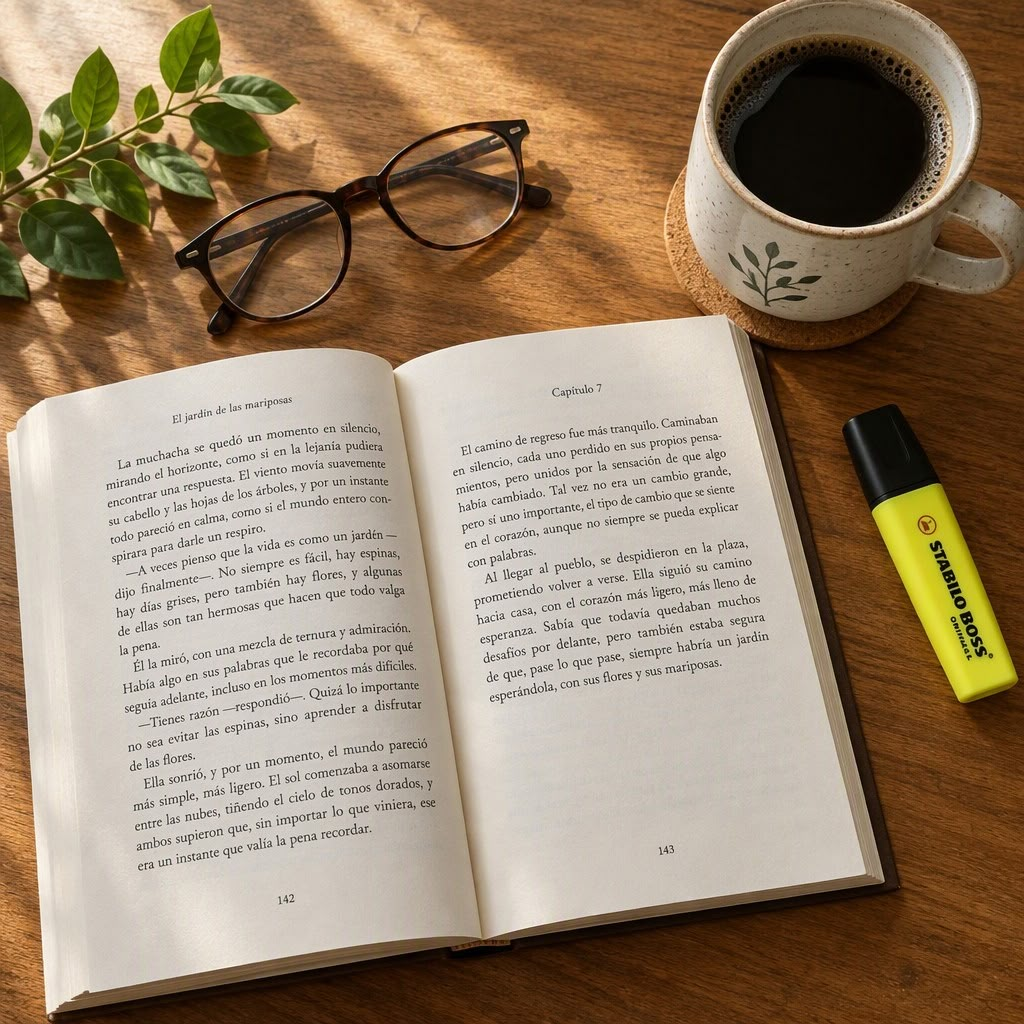
Introduction - Books To Read When Learning Spanish
Stepping into the world of Spanish literature is one of the most powerful moves you can make for your language journey, yet traditional school systems often get it completely wrong. Instead of letting you absorb the rhythm and soul of the language naturally, classrooms force you to hack away at endless conjugation charts and dry grammar rules with little to no meaningful context.
True fluency does not come from memorizing verb tables. It comes from consuming massive amounts of compelling input where words and sentence structures reveal their meaning organically. When you pick up the right books to read in Spanish, you unlock a masterclass in vocabulary growth, contextual grammar, and improved fluency that no textbook can ever replicate.
How to Choose the Right Book
Finding the right Spanish book is the difference between an exciting immersion experience and throwing your hands up in frustration. When you are building your reading habit, you want to make sure your selections fit your current abilities and keep your momentum alive.
Match your level: Deciding between graded readers and native material comes down to avoiding overwhelm. If you jump straight into dense, unadapted literature too early, you will spend all your time translating every single sentence instead of absorbing the flow. Start where you can comfortably understand at least 70 to 80 percent of the text without constantly reaching for a dictionary.
Format and features: Modern technology gives you incredible options to streamline your reading. Ebooks with instant definition lookups let you tap an unfamiliar word to see its meaning without breaking your focus, while bilingual editions or audiobooks paired with text provide a multisensory bridge to native pacing.
Interest factor: Pick genres you actually enjoy to maintain motivation. If you love science fiction, murder mysteries, or historical biographies in English, seek out those exact same genres in Spanish so your desire to find out what happens next overpowers any linguistic friction.
Recommended Books by Level
Navigating your Spanish reading journey requires matching your current comprehension level with texts that challenge you just enough to foster growth without causing burnout. Here is how to break down your reading list across every stage of acquisition.
Beginner (A1–A2)
At the absolute beginner stage, your primary goal is building confidence and accumulating high-frequency vocabulary without getting bogged down in complex syntax.
Graded readers and children's picture books: These resources provide heavily controlled vocabulary and simple sentence structures so you can grasp context naturally.
Side-by-side bilingual editions: Side-by-side texts allow you to glance at your native language only when truly stuck, keeping your momentum alive.
Top Picks: Engage with proven introductory tools like "Short Stories in Spanish for Beginners" by Olly Richards for natural, compelling narrative context, or "Pobre Ana" by Blaine Ray for an accessible, low-friction entry point into reading full storylines.
Intermediate (B1–B2)
Once you have built a solid foundation of basic vocabulary, it is time to transition away from artificial learning texts and step into more natural content.
Simplified classics, short story collections, and YA novels: Young adult fiction and short stories use conversational language and modern dialogue that mirrors how native speakers actually talk.
Top Picks: Bridge the gap into native material with "La Sombra del Viento" by Carlos Ruiz Zafón for rich, atmospheric storytelling, or dive into popular translated works like "Harry Potter y la Piedra Filosofal" where a familiar plot makes processing native phrasing much more intuitive.
Advanced (C1–C2)
At the advanced stage, you are no longer learning Spanish as a subject. You are using Spanish as a tool to gain knowledge, explore culture, and enjoy literature.
Contemporary novels, native-level essays, and newspapers: Dive into unadapted literature written by native authors to master subtle idioms, cultural nuances, and advanced narrative structures.
Top Picks: Push your fluency to the absolute peak with Gabriel García Márquez's legendary magical realism masterpiece "Cien años de soledad", or dive into Isabel Allende's sweeping multigenerational epic "La casa de los espíritus" for rich cultural and historical immersion.
How to Read Effectively for Maximum Fluency
Reading in Spanish is a primary engine for building deep, subconscious comprehension. If you want to turn a simple book into a fluency accelerator, you need to engage with the text through active strategies and multimodal practice.
Active strategies: Do not just look at the words on the page and hope for the best. Annotate key phrases, underline recurring sentence structures, and maintain a vocabulary list using spaced repetition software to lock relevant words into your long term memory.
Multimodal practice: Combine your senses by shadowing audiobooks while reading the text in real-time, matching native pronunciation to the written word. To take your active output to the next level, pause after each chapter and summarize what you just read out loud or in writing entirely in Spanish.
Reading Plans & Challenges
Building a sustainable reading habit demands a structured game plan that keeps you moving forward without burning out. When you anchor your daily routine with clear milestones, reading transforms from an overwhelming chore into an effortless part of your day.
30-Day Starter Plan: Dedicate 10 to 20 minutes daily exclusively to graded readers. By keeping the time commitment short and the material accessible, you build the psychological momentum needed to prove to yourself that you can follow through.
3-Month Progression: Gradually scale up your material by moving steadily from beginner texts to intermediate short stories and youth novels. This deliberate progression allows your vocabulary and contextual comprehension to compound naturally over time.

0 comments