


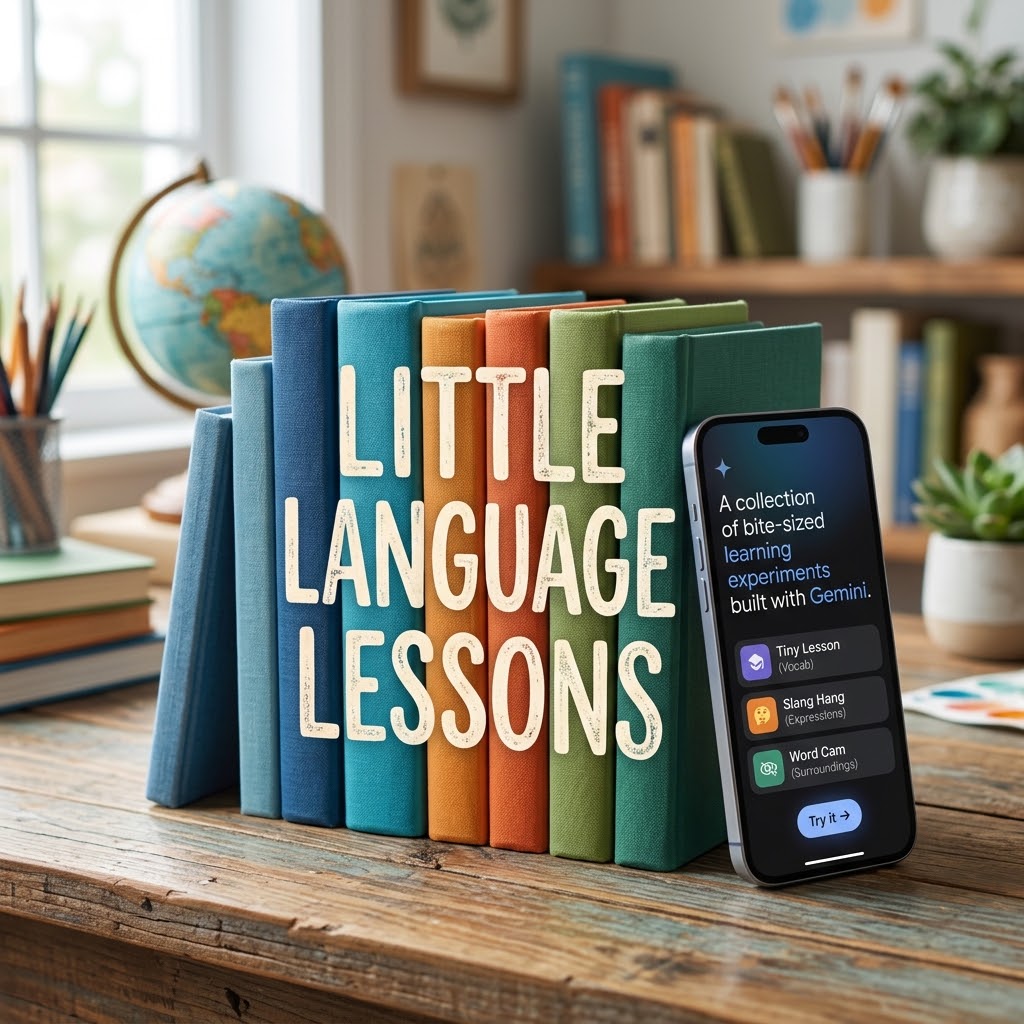
What Are Google’s Little Language Lessons?
If you have ever tried to learn a language through a textbook or a grammar-heavy app, you already know the frustration. You memorize rules, drill vocabulary, and then the moment you try to use the language in a real conversation, everything falls apart. Google's Little Language Lessons is trying to change that.
Little Language Lessons is an experimental project that lives inside Google Labs, the company's sandbox for testing new ideas powered by its Gemini multimodal AI models. It is not a fully launched product yet, but what is already available is worth paying attention to. The experiment is designed to move language learning away from the rigid, one-size-fits-all structure of traditional methods and toward something far more dynamic and contextually relevant.
What makes this particularly interesting is the role that generative AI plays in the experience. Rather than presenting learners with static exercises pulled from a textbook, Little Language Lessons uses Gemini to generate vocabulary, phrases, and grammar tips that are tailored to real-world situations. In other words, instead of learning how to conjugate a verb in isolation, you learn it in a context that actually mirrors how the language is used in everyday life. That shift, from abstract rules to situational meaning, is a big deal for anyone serious about reaching fluency.
The 3 Core Experiments: Features & Mechanics
Little Language Lessons is not a single tool. It is actually made up of three distinct experiments, each one targeting a different aspect of language acquisition. Here is a closer look at what each one does.
Tiny Lesson
Tiny Lesson is probably the most straightforward of the three. You describe a situation you are likely to encounter, and Gemini generates the vocabulary, custom phrases, and grammar tips you need to handle it. Think of it as having a language tutor on standby who can prepare you for a job interview, a restaurant conversation, or a trip to the market in your target language, all in a matter of seconds. The situational relevance here is what sets it apart from traditional flashcard apps that have no sense of context.
Slang Hang
Slang Hang takes things a step further by focusing on the kind of language that textbooks almost never teach. This experiment exposes learners to natural conversations, regional idioms, and the rhythms and patterns of how native speakers actually talk, which is sometimes called conversational prosody. If you have ever felt fluent on paper but completely lost in a real conversation, Slang Hang is addressing exactly that gap.
Word Cam
Word Cam is perhaps the most visually creative of the three experiments. Using Gemini's visual models, it allows you to point your camera at objects in your real-world environment and instantly receive vocabulary associated with what it sees. Your kitchen, your office, your commute, all of it becomes a potential language lesson. It is immersive, it is immediate, and it turns passive moments into active learning opportunities.
Pedagogical Strengths & AI Limitations
Little Language Lessons does a number of things really well, and it is worth acknowledging those strengths before getting into where it falls short.
What It Gets Right
One of the biggest wins here is the emphasis on micro-practice habits. One of the most common reasons people abandon language learning is the belief that they need large blocks of time to make meaningful progress. Little Language Lessons challenges that assumption by delivering bite-sized, high-value learning moments that can fit into almost any schedule. A two-minute Tiny Lesson while waiting for your coffee is still two minutes of situational, contextually rich exposure to your target language.
The situational relevance is also a genuine strength. Language learning works best when it is connected to real-world meaning, and all three experiments are built around that principle. Rather than drilling grammar rules in a vacuum, learners are consistently exposed to language the way it actually functions in everyday life. This aligns closely with active learning principles, where engagement and application drive retention far more effectively than passive memorization ever could.
Where It Falls Short
That said, Little Language Lessons is still an experiment, and it shows. One of the most significant drawbacks is the risk of AI hallucinations, where the model generates information that sounds confident but is factually incorrect. In a language learning context, that is a real problem. A learner who picks up a hallucinated phrase or an artificially constructed slang expression and uses it with a native speaker could end up confused or embarrassed.
Speaking of slang, Slang Hang in particular carries the risk of producing expressions that feel unnatural or regionally inaccurate. Generative AI models learn from vast amounts of text data, but that does not always translate into a nuanced understanding of how slang actually evolves and varies across different communities and regions.
Finally, it is worth remembering that Little Language Lessons is still constrained by its Google Labs status. It is not a polished, fully supported product, which means inconsistent availability, limited language options, and no guarantee that any of these experiments will make it into a final release.
How Little Language Lessons Compares to Traditional Apps
If you have spent any time in the language learning space, you are probably familiar with apps like Duolingo and Babbel. They are polished, well-marketed, and easy to pick up. But familiarity does not always equal effectiveness, and understanding how Little Language Lessons differs from these platforms can help you make smarter decisions about how you spend your study time.
Google Labs vs. Duolingo and Babbel
Duolingo and Babbel are built around structured gamification. They use streaks, points, levels, and rewards to keep you coming back every day. That is not inherently a bad thing, consistency matters in language learning, but the gamification model has a ceiling. The exercises tend to be repetitive, the context is often artificial, and the focus on completing lessons can become more important than actually absorbing the language. You can maintain a 300-day streak on Duolingo and still struggle to hold a basic conversation.
Little Language Lessons operates from a completely different philosophy. Instead of guiding you through a predetermined curriculum, it responds to your real-world needs in real time. The context is dynamic, the content is generated on the fly, and the learning is driven by situations you actually care about. In that sense, it is less of a course and more of an intelligent language companion.
How To Combine Both Approaches
The smartest approach is not to choose one over the other but to use each tool for what it does best. Apps like Duolingo can be useful for building foundational vocabulary and maintaining daily consistency. Little Language Lessons can then layer real-world context and conversational depth on top of that foundation. Think of it as using structured apps to build your base and AI experiments to bring that base to life.
That said, even combining these two approaches leaves a significant gap. Neither one addresses the deeper question of how you as an individual actually learn best. And that is where a more personalized, input-driven method becomes essential.
Future Outlook
Little Language Lessons is just the beginning. To understand where AI-powered language learning is headed, it helps to zoom out and look at the bigger picture of what models like Gemini and Google's specialized LearnLM are capable of and where they are likely to take us.
How Gemini and LearnLM Are Shaping Personalized Tutoring
LearnLM is Google's education-focused AI model, built on top of Gemini and specifically designed with learning science in mind. Where general-purpose AI models are trained to generate useful responses, LearnLM is trained to think like a tutor. That means adapting to the pace of the learner, asking questions that promote deeper thinking, and providing feedback that is both accurate and encouraging. As these models continue to improve, the gap between having access to a world-class language tutor and not having one is going to narrow significantly.
For language learners, this is genuinely exciting. Imagine an AI that not only generates situational vocabulary on demand but also tracks your progress over time, identifies your weak points, adjusts the difficulty of its responses accordingly, and converses with you in your target language with the patience of a tutor who never gets tired. That future is closer than most people realize.
Key Takeaways for Self-Learners and Educators
For independent self-learners, the rise of tools like Little Language Lessons and LearnLM signals one important thing. The excuse of not having access to quality language learning resources is quickly becoming obsolete. The tools are getting better, more accessible, and more personalized with every passing month.
For educators, the challenge is different. The question is no longer whether AI can supplement language instruction but how to integrate it thoughtfully without losing the human elements that make language learning meaningful. Connection, culture, and community are things that no AI model has fully replicated yet.
That said, for all the promise that generative AI holds, technology alone is not a complete solution. The most sophisticated AI tool in the world still cannot tell you who you are as a learner, what your optimal input sources are, or how to build a language habit that actually sticks in your real life. That requires a different kind of approach entirely.
A Smarter Path to Romance Language Fluency
AI tools like Little Language Lessons are impressive, and they are only going to get better. But here is the truth that no app or AI experiment will tell you. The biggest obstacle standing between you and fluency is not access to the right tool. It is not your age, your schedule, or your natural ability either. The real problem is that most language learners have never been given a system that is built around how they specifically learn best.
That is exactly what the NLP Language Mastery Method is designed to solve.
Who This Is For
This method was built for native English speakers who are serious about mastering Romance languages like Spanish and French. If you have tried apps, classes, and online courses only to find yourself stuck at the basics, frustrated by slow progress, and wondering whether fluency is even possible for someone like you, you are in the right place. Your past failures were not personal failures. They were methodology failures. The right system changes everything.
Step One: Identify What Kind of Learner You Are
Most language learning programs hand every student the same curriculum and hope for the best. The NLP Language Mastery Method starts somewhere completely different. Before you touch a single lesson or open a single app, the first step is figuring out who you are as a language learner. Drawing on principles from Neuro-Linguistic Programming, this step helps you understand how your brain processes and retains new information so that every decision you make from this point forward is built around your unique cognitive strengths rather than someone else's learning style.
Step Two: Choose the Right Tools and Resources for Your Profile
Once you know your learner profile, the second step is selecting the tools and resources that actually match it. This is where input-based learning comes into play. Rather than drilling grammar rules and memorizing vocabulary lists in isolation, the focus is on consuming massive amounts of content in your target language. Videos, podcasts, books, and real-world media all become part of your learning environment. The input you consume is not random either. It is chosen specifically to match your interests, your level, and your learner profile so that every hour you spend is working for you rather than against you.
The Esperanto Advantage
One of the most distinctive elements of this method is the use of Esperanto as a bridge language. Esperanto is the world's most successful constructed language and it was intentionally designed to be easy to learn. Its grammar is logical and consistent, its vocabulary draws heavily from Romance languages, and most dedicated learners can reach conversational fluency within a year. By building a foundation in Esperanto first, you develop an intuitive feel for the structure and rhythm of Romance languages that dramatically accelerates your progress in Spanish and French. It is an unconventional approach, but the results speak for themselves.
Step Three: Install Your Language Learning Habit
Knowing what to do is only half the battle. The third and final step is installing your language learning habit into your daily life so that it happens consistently, regardless of how motivated you feel on any given day. This is where most learners fall apart. They rely on inspiration rather than systems. The NLP Language Mastery Method treats consistency as a skill that can be built, not a personality trait you either have or do not have. Even 15 minutes a day, applied consistently over time, will put you miles ahead of someone who studies for hours occasionally and then disappears for weeks.
Ready to Find Your Path to Fluency?
If you are a native English speaker who is serious about mastering Spanish, French, or other Romance languages, the NLP Language Mastery Method was built for you. The first step is discovering your unique learner profile and building a personalized strategy around it. For mor information, check out my flagship course, The Polyglot Blueprint, which breaks down the NLP Language Mastery Method in full.

0 comments