


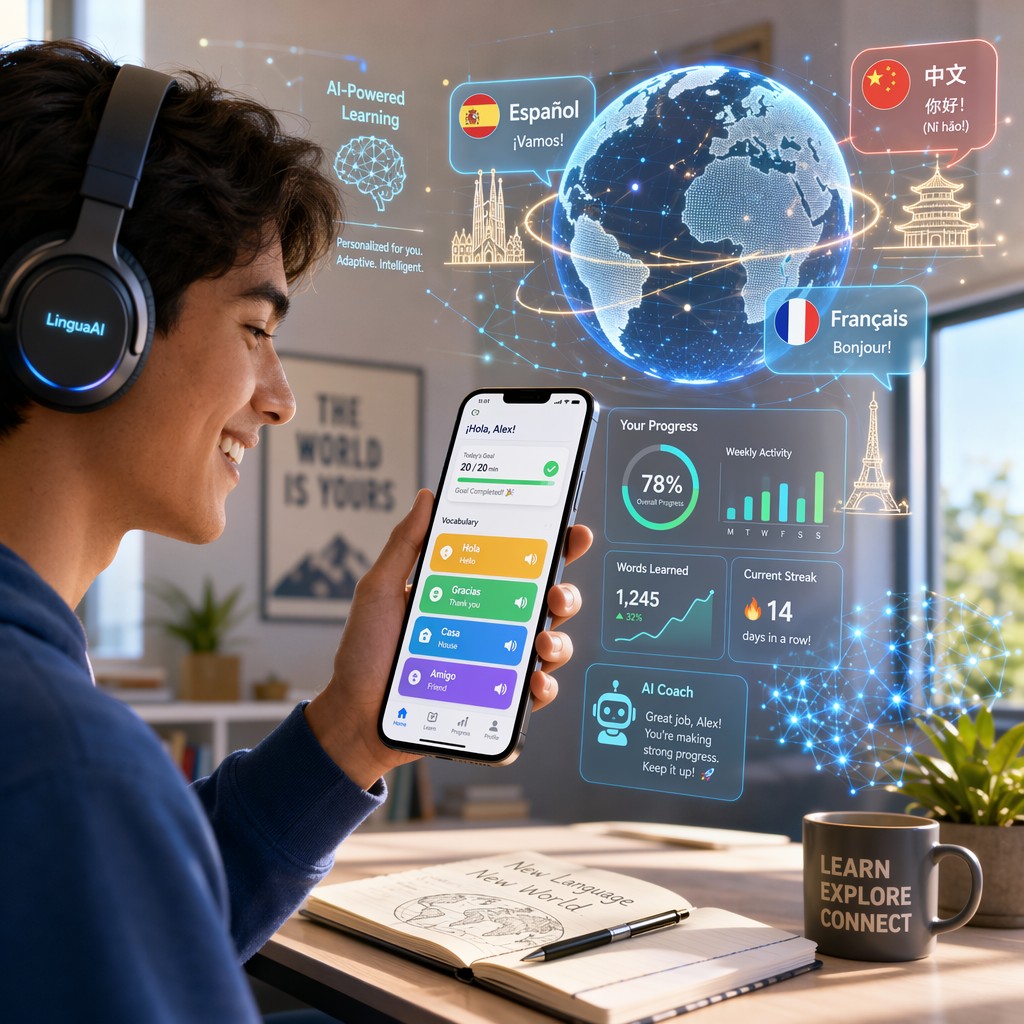
Introduction - Language Learning with AI
Artificial intelligence has quietly revolutionized how we approach language acquisition. What once required expensive tutors, immersion programs, or years of classroom drilling can now be personalized, adaptive, and accessible to anyone with an internet connection. Language learning with AI refers to using machine learning algorithms and intelligent software to enhance, accelerate, and customize the language learning process.
But here's what matters most: AI isn't just making language learning faster. It's making it smarter by meeting you where you are, understanding how your brain learns best, and delivering content in a way that actually sticks. In today's world where multilingualism is increasingly valuable for career advancement, cultural connection, and personal growth, having an AI-powered system that adapts to your unique learning style is no longer a luxury. It's becoming a necessity.
In this article, we'll explore how AI is transforming language education, examine the tools that work best for input-based learners, discuss the limitations you should be aware of, and show you how to leverage AI effectively alongside proven learning methods like spaced repetition and immersive content consumption.
Why Choose AI for Language Learning?
The traditional language classroom operates on a one-size-fits-all model. Everyone learns grammar in the same sequence, moves at the same pace, and reviews the same vocabulary whether they need it or not. AI breaks this mold entirely through personalization. Modern AI-powered platforms analyze your mistakes, track which words you struggle with, and adjust difficulty levels in real time. Instead of grinding through generic lessons, you get an adaptive learning path tailored to your strengths and weaknesses.
This is crucial because, as we know, language learners have vastly different cognitive preferences. Some people absorb language through reading, others through listening, and still others through conversation. AI systems can identify your learning profile and serve content accordingly.
Beyond personalization, AI enables unprecedented scalability. A single AI tutor can support thousands of learners simultaneously, which means language education becomes accessible to people in remote areas, those with limited budgets, and anyone whose schedule doesn't fit traditional classroom hours. You're no longer dependent on finding the right human teacher in your location or paying premium rates for one-on-one instruction.
Finally, accessibility is transformed. AI-powered language learning platforms offer 24/7 practice without judgment or scheduling constraints. Whether you have 15 minutes before work or you want to study at 2 AM, the system is there. Many offer low-cost or even free options, removing financial barriers that have historically kept language learning exclusive. This democratization of language education means that almost anyone, regardless of their background or circumstances, can begin their multilingual journey.
Core AI Technologies Powering Language Learning
Behind every effective AI language learning tool are several sophisticated technologies working in concert. Natural Language Processing, or NLP, is the foundation. It allows AI systems to understand the nuances of human language, from grammar rules to contextual meaning, and generate responses that feel natural rather than robotic. When you're practicing conversation or getting feedback on your writing, NLP is analyzing your input and determining not just whether you're correct, but why certain phrases work better than others.
Complementing NLP is speech recognition and synthesis technology. Speech recognition listens to your pronunciation and compares it against native speakers, giving you immediate feedback on accent and intonation. Speech synthesis, meanwhile, generates high-quality audio so you hear authentic pronunciation from the beginning of your learning journey. This matters tremendously for input-based learners who rely heavily on consuming native content.
Machine learning and recommendation engines take personalization further by analyzing patterns in your learning behavior. These systems track which topics you engage with longest, which vocabulary words you revisit most often, and which content types produce the best retention. The recommendation engine then uses this data to serve you increasingly relevant material, ensuring you're always working on what will benefit you most.
Finally, emerging AI integrations with computer vision, augmented reality, and virtual reality are creating immersive experiences that go beyond traditional screen-based learning. Imagine pointing your phone at a restaurant menu in your target language and having AR instantly translate and pronounce each dish, or practicing conversation with a VR avatar that responds naturally to what you say. These technologies transform language learning from an abstract exercise into a contextual, real-world simulation.
Practical Benefits for Learners
The theoretical advantages of AI mean nothing if they don't translate into real results. For language learners, the practical benefits are substantial and measurable. First, vocabulary and grammar acquisition accelerates significantly when AI implements spaced repetition correctly. Unlike static flashcard decks or textbooks, AI systems know exactly when you're about to forget a word and serve it back to you at the optimal moment for retention. This has been scientifically proven to increase learning rates, and when combined with targeted feedback that explains not just what you got wrong but why, the learning curve flattens dramatically.
Real-time corrective feedback transforms the learning experience. In traditional language classes, you might practice pronunciation once a week with a teacher who corrects you on a subset of your mistakes. With AI, every utterance is analyzed instantly. You say a word with incorrect stress or intonation, and the system provides immediate audio feedback showing you the difference between your pronunciation and the native standard. The same applies to syntax and grammar in written exercises. You learn faster because the feedback loop is instantaneous rather than delayed by days or weeks.
Beyond the mechanics of acquisition, motivation and engagement matter enormously for long-term success. Many AI platforms use gamification strategically, creating scenarios where language learning feels like exploration rather than drilling. Interactive simulations let you practice ordering food at a restaurant, negotiating a business deal, or having casual conversation with a virtual character who responds realistically to what you say. This contextual, scenario-based practice is far more engaging than memorizing isolated phrases, and it builds confidence because you're practicing in realistic situations before you encounter them in real life.
Real-World Use Cases and Examples
Understanding how AI works in theory is one thing. Seeing it in action makes the possibilities real. AI tutors and chatbots have evolved far beyond scripted responses. Modern conversational AI can engage you in natural dialogue, adapt to your proficiency level mid-conversation, and even recognize when you're struggling with a particular grammar pattern and adjust accordingly. These tools provide something previously available only to wealthy learners with access to private tutors: unlimited conversation practice with immediate correction. You can practice at your own pace, revisit difficult topics repeatedly without judgment, and build conversational confidence before speaking with actual humans.
Automated writing evaluation tools represent another major use case. Instead of waiting for a teacher to grade your essay or forum post, AI analyzes your writing in real time, identifying grammar errors, suggesting vocabulary improvements, and explaining why certain structures are more appropriate than others. Some systems even track your recurring mistakes, helping you recognize patterns you might otherwise miss. This transforms writing from a high-stakes activity into a low-pressure practice opportunity where you receive consistent, detailed feedback.
Personalized lesson plans and progress dashboards take the guesswork out of language learning. Rather than wondering what to study next or how you're progressing, AI systems visualize your journey. They show you which vocabulary categories you've mastered, which grammar concepts still need work, and recommend specific content to address your gaps. This data-driven approach removes the overwhelm that comes from not knowing where to focus your limited study time.
Immersive VR role-plays and language simulations represent the cutting edge of AI language learning. In a virtual environment, you might find yourself as a customer in a Parisian cafe, a business professional in a Spanish boardroom, or a traveler navigating a French train station. The AI responds realistically to your choices and language, creating scenarios where you practice authentic communication in contextual settings that feel genuinely immersive.
Effective Learning Strategies with AI
AI is a powerful tool, but it's not a complete solution on its own. The most successful language learners understand how to integrate AI into a broader learning ecosystem. Combining AI practice with human instruction and cultural exposure creates a richer, more sustainable learning experience.
An AI chatbot can give you unlimited conversation practice, but a human conversation partner or teacher provides nuance, cultural context, and the motivation that comes from genuine human connection. Similarly, consuming native content like films, podcasts, and literature exposes you to how language actually functions in the wild, beyond the structured scenarios that AI platforms provide. This combination prevents you from becoming fluent in "AI-speak" while remaining disconnected from authentic language use.
Setting measurable goals and leveraging AI analytics transforms vague aspirations into concrete progress. Instead of saying "I want to be fluent in Spanish," define specific targets like "I want to understand 80 percent of a native Spanish podcast without subtitles" or "I want to hold a ten-minute conversation about travel without hesitation." AI dashboards then show you exactly how you're tracking toward these goals. You can see which vocabulary categories contribute most to your target, which grammar structures appear most frequently in your chosen content, and how your comprehension speed is improving week by week. This data-driven approach keeps motivation high because progress becomes visible and measurable.
Balancing receptive and productive activities is crucial for developing true proficiency. Many learners overemphasize one at the expense of the other. AI makes it easy to consume massive amounts of input through listening and reading, but without speaking and writing practice, you develop a passive understanding that doesn't translate to actual communication. The most effective strategy uses AI to track your balance. Spend time listening to native content and reading authentic materials, but also dedicate consistent effort to speaking and writing exercises where AI provides immediate feedback.
Lastly, treat AI error logs as a learning goldmine. Most platforms track your mistakes and show patterns in what you struggle with most. Rather than moving forward blindly, use this data strategically. If your error log shows you consistently confuse subjunctive and conditional moods, or struggle with a particular set of vocabulary, make those your focus for the next week. This targeted approach to weakness elimination is far more efficient than random studying, and it prevents frustration from repeatedly encountering the same mistakes.
Popular Tools and Platforms
The landscape of AI-powered language learning tools has exploded in recent years, offering options for nearly every learning style and budget. Conversational AI bots represent one category, providing unlimited dialogue practice with systems that understand context and adapt to your level. These tools are invaluable for building speaking confidence and practicing real-world scenarios without the anxiety of speaking with a human partner.
Pronunciation trainers form another category, using advanced speech recognition to analyze your accent, intonation, and stress patterns against native speakers. They're particularly useful for input-based learners who want to ensure their listening comprehension translates into accurate production.
Adaptive course platforms combine multiple technologies to create personalized learning paths that evolve based on your performance, engagement, and stated goals. These platforms often integrate spaced repetition, interactive exercises, and progress tracking into a cohesive system.
When evaluating any platform, several criteria matter.
Accuracy is of fundamental importance. The feedback AI provides must be linguistically sound, especially for grammar correction and pronunciation analysis. Poor feedback can reinforce bad habits rather than correct them.
Personalization determines whether the platform adapts to your unique learning style or forces you into a generic mold. Some systems excel at understanding whether you learn better through text, audio, or interactive scenarios, while others offer minimal customization.
Data privacy deserves serious consideration. Language learning apps often collect substantial data about your learning patterns, mistakes, and sometimes even voice recordings. Understand what data the platform collects, how it's stored, and whether it's sold to third parties.
Cost varies dramatically, from free options with limited features to premium subscriptions or one-time purchases. Your budget matters, but don't assume expensive means better. Some affordable or free tools outperform costly alternatives for specific use cases.
To find your ideal platform, trial multiple tools. Most offer free trials or freemium versions that let you experience the core features without commitment. Spend at least one week with each tool, focusing on whether it aligns with your learning style, whether the feedback feels accurate, and whether you're genuinely motivated to return to it daily. Track specific outcomes like vocabulary retention rate or improvement in comprehension speed rather than relying on subjective impressions. Compare tools side-by-side using this data, and remember that the best platform is the one you'll actually use consistently.
Measuring Progress and Effectiveness
Measuring language learning progress goes beyond subjective feelings of improvement. AI systems excel at capturing objective data that reveals whether your efforts are actually moving you toward fluency. Key metrics provide the foundation for this assessment.
Fluency indicators measure your ability to understand and produce language at speed and with minimal hesitation. AI can track comprehension speed by timing how long it takes you to understand native content, or measure production fluency by analyzing the pauses and false starts in your speech.
Vocabulary retention metrics show what percentage of words you've learned remain accessible after weeks or months, revealing whether your spaced repetition strategy is actually working or if you're forgetting as fast as you're learning.
Pronunciation accuracy scores compare your speech patterns against native speakers across multiple dimensions like stress, intonation, and individual phoneme clarity.
Engagement rates indicate whether you're maintaining the consistency required for long-term success, flagging when motivation dips before it derails your progress entirely.
AI analytics and dashboards transform raw data into actionable insights. Rather than drowning in spreadsheets, you see visual representations of your progress over time. A dashboard might show that your vocabulary retention improved from 65 percent to 82 percent over two months, or that your comprehension speed increased from understanding 40 percent of native content to 65 percent. More importantly, these dashboards highlight what's working and what isn't. If you notice that listening practice produces better retention than reading, you can adjust your study ratio accordingly. If a particular tool or content type correlates with engagement drops, you can swap it out before motivation collapses.
For serious learners committed to validating their progress, A/B testing and longitudinal studies provide deeper insight. A/B testing involves comparing two learning approaches over a fixed period. For example, you might study Spanish using conversational AI for 2 weeks, then switch to immersive content consumption for two weeks, measuring vocabulary retention and comprehension improvements from each method. Longitudinal studies track your progress over months or years, revealing long-term trends that short-term metrics miss. They answer questions like whether your gains in listening comprehension sustain over six months, or whether you plateau at a certain level without intervention.
Challenges, Risks, and Ethical Considerations
While AI offers tremendous potential for language learning, it's not without significant challenges and risks that deserve serious attention.
Biases embedded in language models represent a real concern. AI systems are trained on massive datasets of text, and those datasets reflect the biases of the societies that produced them. A language model trained primarily on formal written English might underrepresent colloquial speech, regional dialects, or slang used by marginalized communities. This means learners might develop a version of the language that's technically correct but culturally narrow.
Similarly, cultural misrepresentations can occur when AI generates examples or scenarios that reflect stereotypes rather than authentic cultural nuance. If a conversational AI consistently portrays Spanish speakers in certain stereotypical ways, or generates examples that reinforce cultural clichés, learners absorb those distortions as accurate representations. This is particularly problematic for language learning, which should open doors to genuine cultural understanding rather than reinforce misconceptions.
Privacy and data security concerns cut to the heart of how comfortable you should be with AI platforms. Language learning apps collect extraordinarily detailed data about you: your mistakes, your learning patterns, your voice recordings, your vocabulary weaknesses, even your emotional state based on engagement patterns. How is this data protected? Is it encrypted? Could it be hacked? Is it sold to advertisers or third parties? Many learners underestimate the sensitivity of this information. Your language learning data could reveal your native dialect, your socioeconomic background, your interests, and vulnerabilities. Before committing to a platform, thoroughly research its privacy policy and data handling practices. If you can't find clear answers, that's a red flag.
The risk of overreliance on AI presents a more subtle challenge. AI excels at certain tasks—delivering consistent feedback, tracking patterns, personalizing content—but it struggles with the irreplaceable elements of human interaction. A human conversation partner brings unpredictability, genuine emotional investment, and the ability to understand context in ways AI still cannot. An AI chatbot will never truly understand why your language learning matters to you, or adjust its approach based on your emotional state the way a skilled human tutor can. Over-relying on AI without human interaction can lead to technical proficiency without authentic communication ability.
Additionally, motivation is partially driven by human connection. Many language learners persist because they have a teacher they respect, a conversation partner they enjoy talking with, or a community of fellow learners who understand their journey. AI, no matter how sophisticated, struggles to replicate this motivational element. The risk is that learners become dependent on gamification and metrics for motivation rather than developing the intrinsic drive that sustains long-term multilingualism.
Finally, accessibility gaps remain a persistent problem. While AI promises democratized language learning, the reality is more complex. High-quality AI tools often require reliable internet, which excludes learners in regions with poor connectivity. They require smartphones or computers that many people cannot afford. Language support is unevenly distributed—you'll find dozens of AI tools for learning Spanish or Mandarin, but far fewer for less commonly studied languages like Esperanto, Lithuanian, or Swahili. Non-English speakers may find fewer tools available in their native language, making it harder for them to learn other languages using AI.
Ensuring equitable access means actively addressing these gaps: developing offline-capable tools, supporting lesser-studied languages, and making platforms truly affordable or free for learners in lower-income regions. Without deliberate effort toward equity, AI language learning risks becoming another tool that advantages the already privileged while leaving others behind.
Future Trends in Language Learning with AI
The trajectory of AI language learning points toward even more sophisticated and immersive experiences. Advances in multimodal models—systems that seamlessly integrate text, audio, video, and images—will create more holistic learning environments. Rather than practicing vocabulary through isolated flashcards, you'll encounter words within rich contextual scenes: watching a video of someone ordering coffee, hearing the native pronunciation, seeing the written dialogue, and understanding the cultural nuances all simultaneously. This mirrors how language is actually acquired in the real world.
Conversational agents will become increasingly human-like, moving beyond the stilted exchanges many learners experience today. Future AI will understand humor, sarcasm, cultural references, and emotional subtext in ways current systems cannot. It will adjust not just the difficulty level but the personality and communication style based on your preferences. Some learners might prefer a formal tutor-like agent, while others want a casual friend-like interaction. The AI will adapt accordingly, making conversation practice feel genuinely human-like rather than robotic.
Integration with AR and VR will transform language learning from screen-based to spatially immersive. Imagine putting on AR glasses and having real-world objects around you labeled in your target language with pronunciation guides. Or stepping into a VR environment where you're genuinely embedded in a Spanish marketplace, a French classroom, or a Japanese train station, interacting with realistic AI characters who respond naturally to your language use. This contextual immersion bridges the gap between abstract learning and real-world application. You'll practice language in scenarios that feel stakes-adjacent to actual use, building neural pathways that transfer more effectively to genuine communication.
Greater personalization will emerge through lifelong learner profiles that persist across platforms and years of study. Rather than starting fresh with each new app, your learning profile accumulates data across your entire language learning journey. The system knows not just your current proficiency level but your learning history, your preferences, your recurring challenges, and your long-term goals. Transfer learning—a technique where insights from learning one language accelerate learning of related languages—will become more sophisticated. Learn Spanish well enough, and the system automatically knows which grammar concepts transfer to French or Italian, and which require fresh attention. Your profile recognizes that you're strong with audio input but weak with written production, and adapts accordingly across all languages you're learning.
Language coverage will expand dramatically, particularly for low-resource languages that currently receive minimal AI support. Languages like Esperanto, minority languages within larger countries, and indigenous languages will gain AI tools as the technology becomes more efficient and as funding prioritizes linguistic diversity. Machine translation quality will approach human parity, making it possible to consume authentic native content in languages where high-quality learning materials currently don't exist. This expansion means that multilingual ambition won't be limited to major world languages, but will become accessible for anyone passionate about any language on earth.
Practical Tips for Learners
For learners, the key to leveraging AI effectively is intentional integration rather than haphazard use. Start by identifying your learning style and proficiency level, then select one or two AI tools that align with those specifics rather than trying to use everything available. Overloading yourself with tools creates analysis paralysis and fragmentation. Once you've chosen your tools, integrate them into a daily routine. This doesn't require hours. Even 15 minutes of consistent AI practice—whether that's reviewing spaced repetition cards, practicing pronunciation, or engaging in conversational exchange—produces measurable progress over weeks and months. The key is consistency, not intensity.
Schedule your AI practice at the same time daily, treating it like brushing your teeth rather than an optional activity. Use AI analytics to inform your routine adjustments. If your error logs show persistent weakness in subjunctive mood conjugations, spend one week focusing intensively on that through AI exercises before moving forward. If engagement metrics show you're losing motivation with a particular tool, swap it for something more engaging rather than forcing yourself through diminishing returns.
Finally, remember that AI is a supplement, not a replacement for human interaction and authentic content consumption. Dedicate at least as much time to consuming native content—podcasts, films, literature, social media in your target language—as you spend on structured AI practice. Seek out human conversation partners, either through language exchange communities or tutors, to ensure your AI-developed skills transfer to genuine communication.
To evaluate new AI language-learning tools, use this comprehensive checklist:
Pedagogical Quality
- Does the tool use evidence-based methods (spaced repetition, comprehensible input, etc.)?
- Is feedback linguistically accurate and pedagogically sound?
- Does it support multiple learning modalities (visual, auditory, kinesthetic)?
- Are learning objectives clear and measurable?
Personalization & Adaptation
- Does the tool assess your learning style and adjust accordingly?
- Does difficulty scale intelligently based on your performance?
- Can you customize what content you focus on?
- Does it track progress and use that data to guide future lessons?
Content Quality & Authenticity
- Is the content created by native speakers or qualified professionals?
- Does it represent authentic language use or just textbook examples?
- Is cultural representation accurate and nuanced?
- Is content regularly updated to reflect current language use?
User Experience
- Is the interface intuitive enough that you can focus on learning, not navigation?
- Does the tool feel engaging enough that you'll return daily?
- Is motivation sustained through progress tracking rather than just gamification?
- Are instructions clear and support readily available?
Privacy & Data Security
- What data does the tool collect?
- How is data encrypted and protected?
- Who has access to your data?
- Can you delete your data upon request?
- Is the privacy policy transparent and readable?
Technical Reliability
- Does the tool work consistently without frequent crashes or bugs?
- Is customer support responsive if you encounter problems?
- Are updates regular but not disruptive?
Cost & Accessibility
- Is pricing transparent with no hidden fees?
- Is there a free trial or freemium option?
- Does it work on your devices (phone, computer, etc.)?
- Is it accessible to users with disabilities?
Language Coverage
- Does it support the language(s) you want to learn?
- Are multiple proficiency levels available?
- Does it support learning related languages you might pursue?
Trial a tool for at least one week before committing. Track specific metrics like vocabulary retention, comprehension improvement, or engagement consistency. Compare your outcomes across tools rather than relying on subjective impressions. The best tool is the one that aligns with your learning style, produces measurable progress, and keeps you motivated to practice daily.

0 comments