


Introduction: What Is Language Learning 101?
Language Learning 101 is your beginner's roadmap to mastering a new language with confidence and clarity. Rather than jumping into random apps or grammar drills, Language Learning 101 provides a structured foundation that transforms how you approach language acquisition.
This foundational approach matters because it addresses 3 critical elements: first, it sustains your motivation by connecting you to your personal "why" for learning, second, it maximizes efficiency by eliminating wasted time on outdated methods that don't align with how your brain actually learns, and third, it delivers measurable progress that keeps you encouraged throughout your journey.
The difference between learners who succeed and those who abandon their goals isn't talent or natural ability. It's having the right structure, the right strategy, and the commitment to show up consistently.
Why Learn a New Language?
Learning a new language unlocks benefits that extend far beyond being able to order coffee in a foreign country.
Cognitively, language learning strengthens your brain's pattern recognition abilities, enhances memory, and improves overall mental flexibility. Career-wise, multilingualism opens doors to opportunities that monolingual speakers simply don't have access to. Travel becomes richer and more authentic when you can communicate with locals in their native tongue, creating genuine connections rather than relying on translation apps.
Perhaps most importantly, learning a language builds cultural empathy by exposing you to different ways of thinking, expressing ideas, and viewing the world. You'll forge social connections with communities you never would have accessed otherwise.
But motivation matters, and it comes in two forms. Extrinsic motivation comes from external rewards like career advancement or impressing others. Intrinsic motivation, however, is the real game-changer: it's the genuine interest and personal connection you feel toward a language or culture. The most successful language learners aren't chasing external rewards. They've identified meaningful, personal reasons to continue when motivation naturally dips.
Setting Goals and Creating a Study Plan
Vague goals like "I want to be fluent" won't get you anywhere. Instead, create SMART goals tailored specifically to language learning: make them specific by defining exactly what you want to achieve (like "hold a 10-minute conversation in Spanish"), measurable so you can track progress, achievable based on your actual life circumstances, relevant to your personal reasons for learning, and time-bound with a clear deadline.
A realistic study plan starts with honest self-assessment about how much time you can consistently dedicate each week. The truth is, consistency beats volume. 15 minutes daily will outperform an occasional three-hour cramming session because your brain needs regular exposure to form lasting connections. Build a weekly or monthly schedule that fits into your existing routines, whether that's a morning coffee ritual, a lunch break, or evening downtime.
Progress tracking transforms abstract effort into tangible wins that keep you motivated. Start a simple language learning journal where you note what you studied, challenges you faced, and breakthroughs you had. Take regular level tests using frameworks like the A1 to C2 scale, which breaks language proficiency into clear milestones you can work toward. Celebrate these checkpoints along the way. When you can track your movement from A1 (beginner) toward B1 (intermediate) or beyond, the invisible progress becomes visible and real.
Core Skills: Listening, Speaking, Reading, Writing
Language mastery rests on 4 pillars: listening, speaking, reading, and writing. The question isn't whether you need all 4, but rather how to prioritize them based on your specific goals. If your goal is conversational fluency, listening and speaking deserve more attention than academic writing. If you're preparing for professional certification, reading and writing become critical. However, neglecting any skill creates gaps that will limit your overall proficiency.
For listening, active listening is an absolute must: don't passively let content wash over you. Instead, engage with podcasts, videos, or audiobooks at your level, pause frequently, and identify words you don't know. Shadowing, where you listen to native speakers and repeat their words aloud, trains your ear and mouth simultaneously. Reading improves through graded readers designed for learners at your level, starting with simple stories and progressing to authentic content. Writing develops through consistent practice with prompts that force you to construct sentences, not just recognize them.
Measure listening improvement by tracking how much of a native-speed podcast you can understand without subtitles. Speaking progress shows up when you can record yourself and notice clearer pronunciation or longer uninterrupted sentences. Reading improves when you finish articles with fewer dictionary lookups. Writing skill jumps when your journal entries become longer, more complex, and grammatically tighter. Checkpoint these improvements monthly by revisiting the same activity you tried weeks earlier and noticing the difference. The best part is that you can do all of this by yourself.
Vocabulary Strategies That Work
Vocabulary is the soul of a language, yet most learners approach it haphazardly, memorizing random words without strategy. Smart vocabulary building starts with prioritization. High-frequency word lists give you the biggest return on investment because the most common words appear constantly in real conversations and content. Beyond frequency lists, organize vocabulary by topics relevant to your life and goals: if you love cooking, learn food vocabulary, if you travel frequently, master travel phrases. This targeted approach keeps learning relevant and engaging.
Spaced repetition systems like Anki revolutionize vocabulary retention by leveraging how your brain actually works. With SRS, difficult words appear more often while easier ones fade into the background, fighting the natural forgetting curve. Flashcards work, but they're most powerful when combined with memory techniques like mnemonics, where you create vivid mental images linking new words to concepts you already know. However, isolated flashcards only take you so far. Contextual learning is where vocabulary truly sticks.
Instead of learning words alone, study collocations, which are words that naturally pair together in your target language. Sentence mining extracts real example sentences from native content, showing you exactly how words function in authentic contexts. This approach matters because it reveals not just what a word means, but how native speakers actually use it.
When you encounter a word in a real sentence from a podcast, article, or conversation, your brain embeds it differently than when it sits alone on a flashcard. Combine high-frequency lists, SRS tools, and contextual learning, and you'll build vocabulary that sticks and transfers to real communication.
Grammar Without the Overwhelm
Grammar intimidates most language learners because traditional education framed it as rules to memorize and exceptions to master. This is backwards. Grammar is simply a tool for communication, not an obstacle standing between you and fluency. You don't need to understand every grammatical rule to speak effectively. Native speakers use grammar intuitively without conscious analysis.
Your goal isn't to become a grammarian. Rather, it's to internalize patterns well enough to express yourself clearly and understand others. Focus on functional grammar: the patterns that actually appear in everyday speech. If you're learning Spanish, the subjunctive mood might feel abstract and overwhelming, but if you narrow it to common phrases like "espero que" or "es importante que," suddenly it becomes manageable and practical.
Input-focused learning accelerates grammar internalization. When you consume native content like podcasts, videos, or articles, your brain naturally absorbs grammatical patterns through exposure rather than explicit instruction. Studying and learning the rule helps, but you also need to encounter it repeatedly in context. Combine input with targeted drills that isolate specific patterns you struggle with, then apply them in real sentences you might actually use.
Corrective feedback matters too. When you speak or write, gentle corrections from native speakers or language partners show you the gap between what you produced and what sounds natural. This feedback loop, especially when paired with continued input, accelerates pattern acquisition.
Skip the overwhelming grammar textbooks and embrace a method where grammar emerges naturally from meaningful exposure and strategic practice.
Proven Methods and Approaches
Language learning methods aren't one-size-fits-all, and successful learners understand that different approaches serve different purposes.
Immersion, where you're surrounded by the language constantly, accelerates learning dramatically but requires travel or relocation. The communicative method prioritizes real conversation over grammar drills, building confidence quickly but sometimes leaving gaps in structured knowledge. Task-based learning focuses on completing real-world tasks in the target language, making learning practical and motivation-driven. Comprehensible input, the foundation of natural acquisition, exposes you to language slightly above your current level so your brain can infer meaning from context.
None of these methods is superior in isolation. Instead, the real power comes from mixing methods strategically. Classroom instruction gives you structure and accountability. Self-study through apps, videos, and reading builds vocabulary and exposure. Conversation practice with native speakers or language partners forces you to produce language under real conditions. Each element fills gaps the others leave.
Your personality and learning style determine which blend works best for you. Visual learners thrive with video content, flashcards, and written materials. Auditory learners excel with podcasts, audiobooks, and conversation partners. Kinesthetic learners need interactive apps, role-playing scenarios, and hands-on practice. The real breakthrough happens when you identify your natural learning preferences and construct a system that leverages them rather than fighting them.
Spend time discovering how your brain learns best, then build a personalized approach that combines proven methods in a way that feels sustainable and engaging for you.
Best Resources and Tools
The language learning landscape is crowded with options, and choosing wisely saves you time and money. Online apps and platforms each serve distinct purposes. Spaced repetition apps like Anki dominate vocabulary retention, while language exchange platforms connect you with native speakers for conversation practice at minimal cost. Online tutors provide personalized feedback and structured lessons on your schedule. MOOCs, or massive open online courses, offer comprehensive curricula often free or low-cost.
Offline resources like books and in-person classes remain powerful despite the digital era. Graded readers designed for learners at your level build reading confidence without overwhelming you. Podcasts in your target language provide free, portable listening practice. Textbooks, when well-designed, offer systematic progression. Local meetup groups and conversation clubs provide human connection and real-world speaking practice that apps can't replicate.
The key is evaluating resources before investing time or money. Ask yourself: Does this resource align with my specific goals? If your goal is conversational Spanish, a grammar-heavy textbook alone won't suffice. What's the cost versus benefit? A free podcast with inconsistent quality might waste more time than a paid course with structured lessons. Does the resource match your learning style and current level? Jumping into native-speed content when you're still at beginner level creates frustration, not progress. Quality matters too. Resources created by language experts and tested with real learners outperform amateur content.
Build your toolkit intentionally, combining apps, platforms, offline resources, and human interaction in proportions that match your goals, budget, and learning style.
Daily Practice & Immersion Techniques
Language learning success isn't built on intensity, it's built on consistency. Micro-practices—focused 10 to 30-minute daily habits—compound dramatically over time. 15 minutes of deliberate practice daily outperforms sporadic three-hour sessions because your brain needs regular exposure to form lasting neural connections. These micro-practices might include reviewing Anki cards while having coffee, listening to a podcast during your commute, or writing 3 sentences in your target language before bed. The magic happens when these small actions become non-negotiable parts of your routine, not something you fit in when motivation strikes.
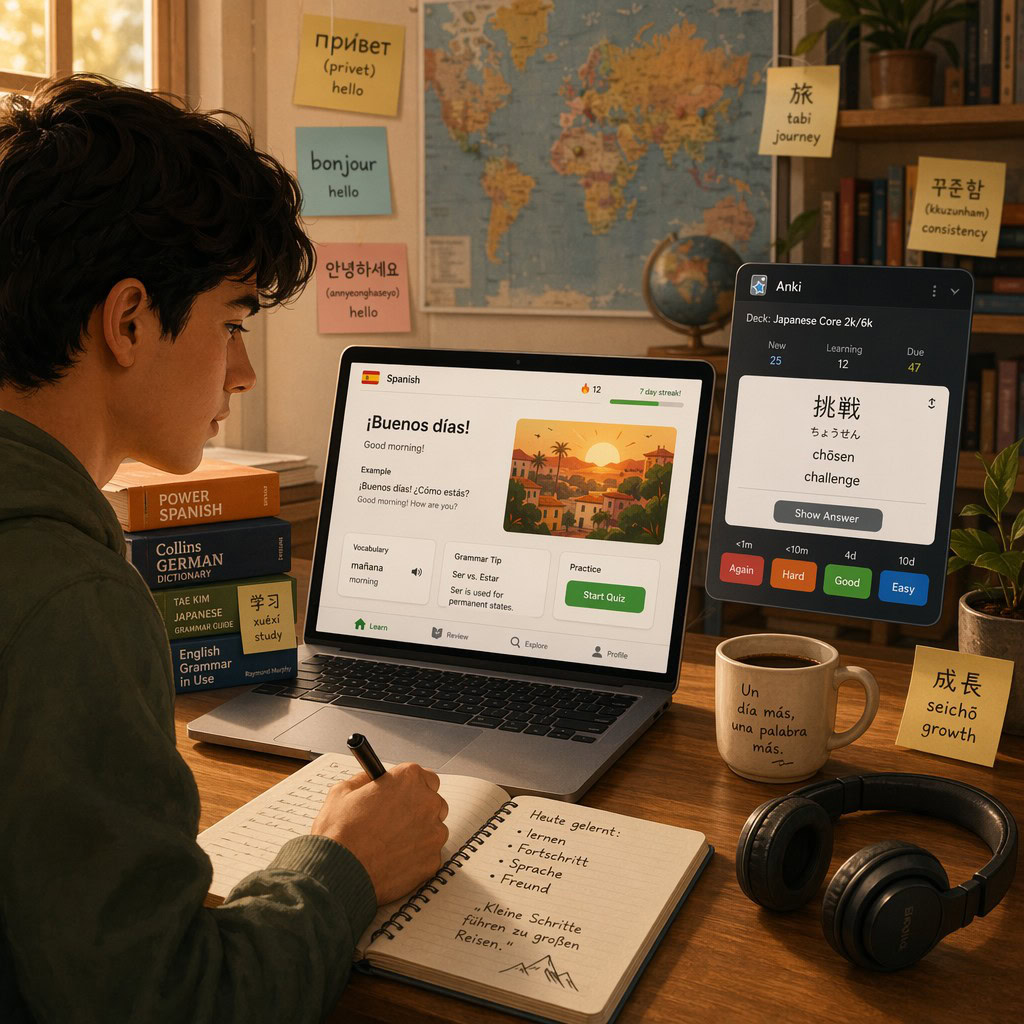
Creating an immersion environment amplifies your progress without requiring travel to a foreign country. Start by changing your phone and computer settings to your target language. Label objects around your home with sticky notes in your target language so you encounter vocabulary naturally throughout your day. Consume media intentionally: watch TV shows, movies, and YouTube videos in your target language with subtitles in your native language, then progress to subtitles in your target language, then no subtitles.
Adjust your social routines by following native speakers on social media, joining online communities of language learners, or finding local groups of speakers. Even travel hacks work: when you travel, stay in hostels where you'll meet locals and other travelers, eat at family-run restaurants instead of tourist chains, and force yourself into situations requiring real communication.
Conversation practice accelerates fluency faster than any solitary study. Find language partners through apps or local meetups who want to exchange conversation in your language for theirs. Hire tutors for structured feedback and guided practice. Practice shadowing by listening to native speakers and repeating their words aloud, training both your ear and mouth simultaneously. Use roleplay scenarios to practice real-world situations like ordering food, booking hotels, or having casual conversations.
The more you speak, make mistakes, and receive gentle corrections, the faster your confidence and competence grow.
Common Challenges and How to Overcome Them
Every language learner hits a plateau where progress feels invisible and motivation crumbles. This isn't failure. It's a predictable part of the journey. Plateaus happen because you've internalized foundational patterns and now need exposure to more advanced material. The solution isn't grinding harder—it's changing your input. Switch from beginner podcasts to native-speed content, move from textbooks to authentic articles, or find a conversation partner who challenges you beyond small talk.
Loss of motivation often signals misalignment between your learning method and your actual goals or learning style. Revisit your "why" every few weeks. Are you still connected to your original reasons for learning? Has your motivation source shifted? It's perfectly okay to adjust your goals or change languages entirely if your interests evolve.
Fear of speaking paralyzes many learners, but it stems from perfectionism and imagined judgment. Native speakers make mistakes constantly and don't judge learners harshly for trying. Start speaking in low-stakes environments: language exchange apps where both parties expect mistakes, tutors paid to be patient, or small study groups where vulnerability is normalized.
Time scarcity is real for busy professionals, but consistency beats volume. Protect just 15 minutes daily rather than searching for impossible hour-long blocks. Bundle learning into existing routines: listen during commutes, review flashcards during lunch, watch shows while exercising. Avoid burnout by taking strategic breaks—rest actually strengthens memory consolidation.
Consistency matters most, and accountability systems keep you showing up. Find an accountability partner, join a study group, or publicly commit to goals on social media. Celebrate small wins and milestones to maintain momentum. Community support transforms a solitary struggle into a shared journey where others understand your challenges and celebrate your victories.
Assessment: How to Measure Progress
Progress invisible is progress unmotivating. Without measurement, you can spend months studying and feel like nothing has changed. Self-assessment tools give you frequent, low-stakes checkpoints. Create simple benchmarks: Can you understand a podcast you couldn't follow three months ago? Can you write longer journal entries with fewer dictionary lookups? Can you hold conversations without long pauses? These informal checks matter because they're directly tied to your real goals.
Standardized tests like the CEFR framework (A1 through C2), TOEFL, DELF, KER, or language-specific certifications provide objective validation and official credentials. Taking a formal test every 6-12 months shows progress that apps and apps alone can obscure.
However, standardized tests measure only certain skills, so combine them with practical assessments. Output, speaking and writing samples, reveals actual competence better than passive comprehension. Record yourself speaking monthly and listen back to notice improved pronunciation, more complex sentence structures, or longer uninterrupted speech. Review writing samples from different time periods to see grammatical improvements and vocabulary expansion.
Input comprehension matters equally. Track how much of native-speed content you understand without subtitles, or how many articles you can read with minimal dictionary help. Your comprehension ceiling often exceeds your production ability, so improving comprehension unlocks speaking potential.
The critical step many learners skip is adjusting their study plan based on assessment results. If speaking assessments reveal weak vocabulary in specific areas, intensify vocabulary study in those domains. If listening comprehension plateaus, switch to more challenging audio content. If writing assessments show persistent grammatical errors, add targeted grammar drills.
Review your progress quarterly, celebrate gains, identify weak areas, and adjust your approach accordingly. This continuous refinement transforms generic study into precision learning aligned with your actual needs.
Advanced Tips & Next Steps After the Basics
Transitioning from beginner to intermediate requires a fundamental shift in mindset and strategy. At the beginner stage, structure matters: textbooks, apps, and guided courses provide the scaffolding you need. At intermediate, you must become autonomous. Stop waiting for perfect lessons and start consuming content you're genuinely interested in, even when it challenges you. This is where your individual passions take over.
If you love cooking, watch cooking shows in your target language. If you follow sports, consume sports commentary and analysis. Your motivation sustains the effort far better than generic textbook dialogues. Increase complexity gradually by seeking native-speed content with minimal scaffolding, reading longer articles and books, and engaging in unscripted conversations where you can't predict what comes next.
Specialized vocabulary accelerates when you need it. If you're learning a language for professional reasons, focus on domain-specific terminology in your field. If you're pursuing academic study, master academic discourse patterns and discipline-specific vocabulary. This targeted approach makes learning practical and immediately applicable. Create flashcard decks specific to your professional or academic context rather than generic vocabulary lists.
Long-term maintenance separates those who reach fluency from those who plateau and regress. After you've achieved your initial goals, many learners abandon their practice, watching skills decay. Instead, build lifelong learning habits. Maintain a review schedule using spaced repetition even after you've "finished" learning. Consume content regularly in your target language—podcasts, books, news, social media—to keep your brain engaged. Join communities of practice where you interact with native speakers or other learners. Set new goals that push you forward: perhaps reading literature, mastering accents from different regions, or learning a third language.
The learners who become true polyglots aren't those with special talent, they're those who treat language learning as a permanent part of their identity, not a temporary project with an endpoint.

0 comments