


Introduction
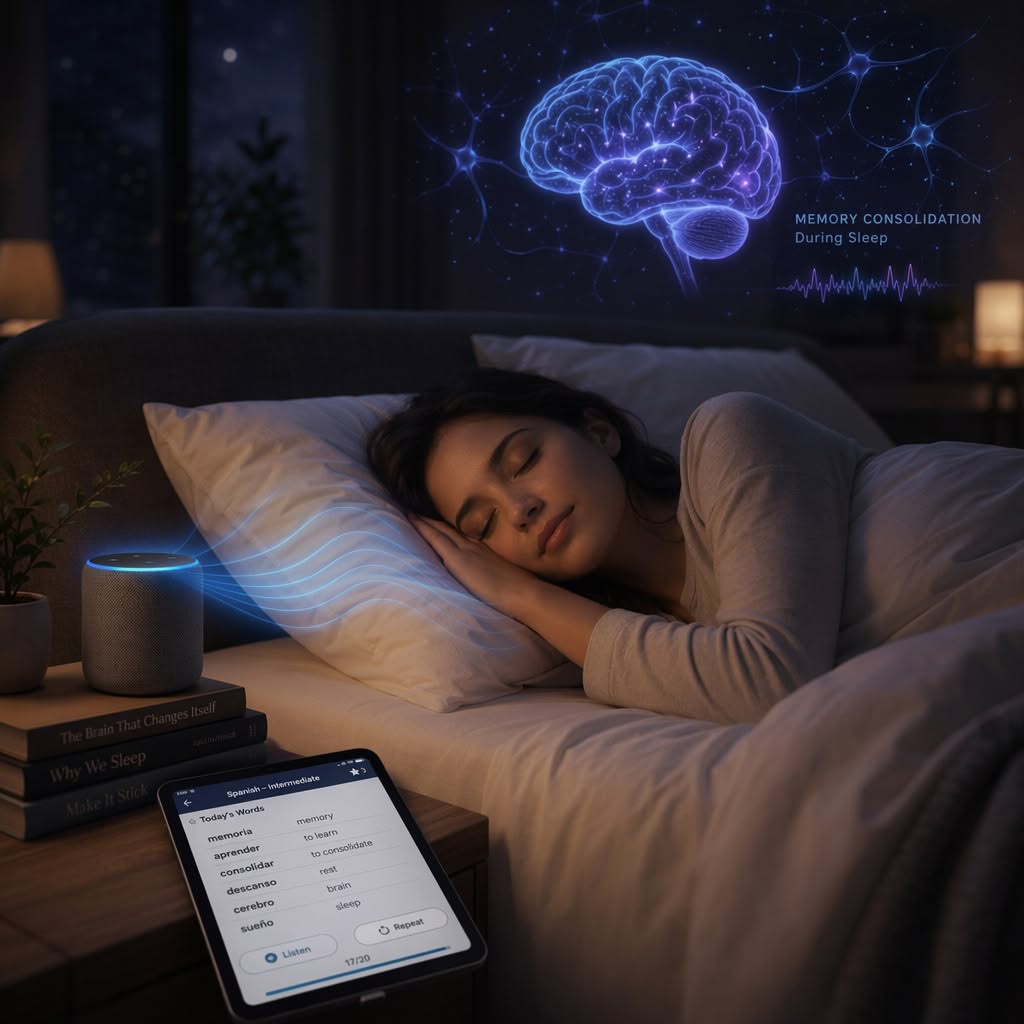
Language learning while sleeping sounds like a dream come true, literally. The idea of absorbing a new language while you rest appeals to busy professionals, students, and language enthusiasts who want to maximize every moment of their day.
But does it actually work?
In recent years, this topic has exploded in popularity thanks to viral claims on social media and the rise of sleep learning apps that promise fast-track language acquisition during your downtime.
The truth is more nuanced than these marketing claims suggest.
In this guide, we'll break down the actual science behind sleep learning, explore proven methods that can genuinely support your language goals, walk you through how to set up an effective sleep learning routine, and give you an honest assessment of both the benefits and limitations of this approach.
By the end, you'll understand whether language learning while sleeping should be part of your language journey or if your time and energy are better spent elsewhere.
The Science Behind Learning During Sleep
Your brain doesn't stop working when you fall asleep. In fact, sleep is when some of the most important memory processes happen.
During slow-wave sleep, your brain consolidates declarative memories, which include facts, vocabulary, and explicit knowledge. REM sleep, on the other hand, plays a crucial role in processing emotional content and integrating new information with existing knowledge. This is where the sleep learning story gets interesting for language learners.
However, there's a critical distinction between passive exposure and active learning. When you're awake and focused, your brain actively encodes new language patterns through attention, repetition, and engagement with meaningful content. This active learning builds strong neural pathways.
During sleep, your brain can strengthen connections that were already formed during waking hours, but it cannot create entirely new learning from scratch. Research from neuroscience shows that while your auditory system continues to process sounds during sleep, your conscious attention shuts down, severely limiting your ability to absorb new vocabulary or complex grammar structures.
Studies have found that people exposed to foreign language audio during sleep show minimal improvement compared to those who don't receive any exposure.
To put it simply, sleep can reinforce what you've already learned while awake, but it cannot replace active, focused language practice.
What "Language Learning While Sleeping" Can and Cannot Do
Let's be honest about what sleep learning can realistically deliver. The primary benefit is vocabulary reinforcement. If you've already studied words during the day through active methods like Anki flashcards or Clozemaster cloze tests, playing audio of those same words during sleep can help solidify them in your long-term memory.
Similarly, exposure to native speaker pronunciation and speech patterns during sleep can familiarize your ear with the sounds and rhythms of your target language, which supports better pronunciation over time. These are genuine benefits, but they're modest and entirely dependent on prior waking study.
What sleep learning cannot do is replace active learning.
You cannot become fluent, learn new grammar rules, or acquire complex sentence structures by passively listening while asleep. Your brain simply lacks the conscious attention needed to process and encode this information. This is where most myths collapse.
The popular narrative that you can "learn a language in your sleep" or achieve fluency through nighttime audio alone is pure marketing fiction.
Another common misconception is that any audio will work equally well. Random foreign language podcasts or movies won't give you the same results as strategically chosen content tied to what you've actively studied.
Finally, many people believe that sleep learning is a substitute for consistent daily effort. It's not. Sleep learning is a supplementary tool at best, useful only when it complements a structured routine of active practice, vocabulary building, and immersion.
Proven Methods and Techniques
If you're going to try sleep learning, there are evidence-based approaches that work better than others. The most scientifically supported method is called targeted memory reactivation, or TMR. In plain terms, TMR means playing specific audio cues during sleep that correspond to information you actively learned during the day.
For example, if you spent your afternoon studying Spanish vocabulary with Anki, you could play audio of those exact words during sleep to strengthen the neural connections you created while awake. Research shows this approach produces measurable improvements in retention compared to passive sleep exposure alone.
Another effective technique is using spaced repetition audio playlists designed specifically for sleep reinforcement. Rather than random content, these playlists strategically repeat vocabulary and phrases you've already encountered, maximizing the reinforcement benefit. Apps like Anki can be paired with audio tools to create customized sleep playlists featuring only the words and concepts you need to review.
The real magic happens when you combine daytime learning with nighttime review in a coordinated system. Your routine might look like this: spend your waking hours actively engaging with language through lessons, flashcards, and native content. Then, as you sleep, play targeted audio of the exact material you studied that day.
This creates a powerful cycle where active learning builds new connections, and sleep consolidation strengthens them. This integrated approach transforms sleep learning from a passive gimmick into a genuine tool that supports your overall language learning strategy.
Types of Audio Content to Use While Sleeping
Not all sleep audio is created equal, and your choice of content directly impacts effectiveness. Native-speaker recordings outperform synthesized speech when it comes to familiarizing your brain with authentic pronunciation, intonation, and natural speech patterns. Your ear picks up subtle nuances from real voices that robotic voices simply cannot provide.
However, synthesized speech has one advantage: consistency.
It eliminates variability, which can be helpful if you're using TMR and need identical audio cues repeated during sleep. For most language learners, native-speaker audio is the better choice, even if it requires more effort to source.
The format of what you're listening to matters significantly.
Single-word lists and short phrases work well for vocabulary reinforcement because they're easy for your sleeping brain to process without requiring context or complex comprehension. Contextual sentences, where words appear in realistic usage, offer additional benefits by reinforcing grammar patterns and natural word combinations you'll encounter in real life.
If you're building a sleep playlist, mixing both formats can be effective: start with isolated vocabulary for direct reinforcement, then include contextual sentences to strengthen broader language patterns.
When it comes to background music or white noise, proceed with caution. Soft background music might help you fall asleep more easily, which is valuable, but it can also compete with the language audio for your brain's limited processing resources during sleep. White noise is generally safer because it masks environmental distractions without interfering with auditory processing.
Many language learners find that keeping sleep audio clear and unadorned, without musical accompaniment, produces the best results for memory consolidation.
Technical Setup and Tools
Getting the technical side right ensures you're actually reinforcing learning instead of damaging your hearing or disrupting your sleep quality. Start with device selection. A bedside speaker works better than earbuds or headphones, which can cause discomfort during long sleep sessions and potentially damage your ears if volume isn't controlled.
Keep volume levels low, around 30 to 40 decibels, which is soft enough to support sleep consolidation without jolting you awake or causing hearing strain. Your audio should be barely noticeable when you're falling asleep, fading into the background of your consciousness.
Several apps excel at supporting sleep learning playlists. Anki, which many language learners already use for spaced repetition during waking hours, can generate audio files that you can export to other apps. Specialized sleep learning apps like Sleep Cycle or similar platforms let you set timed sessions that automatically stop after a set duration, preventing all-night looping that might disrupt deeper sleep stages.
For maximum control, you can create your own audio tracks using free tools like Audacity, which allows you to arrange vocabulary, build in strategic pauses, and loop content precisely.
When creating effective sleep-learning tracks, format matters. Space words or phrases 2 to 3 seconds apart to give your brain time to process without overwhelming it. Keep individual sessions between 20 and 60 minutes, matching the length of lighter sleep cycles.
Frequency is equally important: playing the same content multiple nights in a row activates stronger TMR effects than sporadic exposure. The key is consistency paired with strategic spacing, the same principle that makes Anki so powerful during your waking language routine.
Best Practices and Sleep Hygiene
The timing of when you start your sleep audio matters more than many people realize. Ideally, begin playing your audio as you're falling asleep, during the transition into sleep, rather than waiting until you're already in deep sleep. This allows your brain to encode the initial exposure while you're still semi-conscious, then benefit from consolidation as you move through sleep stages.
Most sleep cycles follow a pattern of light sleep, deep slow-wave sleep, and REM sleep. Playing audio during the first 30 to 60 minutes gives you the best window for auditory processing before you enter the deepest sleep stages. However, prioritize actual sleep quality over sleep learning.
If audio prevents you from falling asleep, wakes you frequently, or leaves you groggy in the morning, stop using it. A full night of quality sleep supports better language learning overall than fragmented sleep with audio playing.
Your general sleep hygiene should remain the same: maintaining consistent sleep schedules, keeping your bedroom cool and dark, and avoiding screens before bed. These practices support the memory consolidation processes that make sleep learning effective in the first place.
Finally, monitor your actual results instead of assuming the method works for you. Keep a simple journal tracking which vocabulary or phrases you studied during the day, whether you used sleep audio that night, and how well you recall that material the next day through testing.
After 2 to 3 weeks of data, you'll know whether sleep learning genuinely boosts your retention or if your time is better spent on active practice and focused study during waking hours.
Measuring Progress and Effectiveness
You cannot improve what you don't measure. To determine whether sleep learning actually benefits your language progress, you need concrete data, not assumptions.
Start with practical vocabulary retention tests. After a week of using sleep audio paired with daytime study, test yourself on the exact words you studied and listened to during sleep. Use simple flashcard apps or written quizzes to measure recognition and recall accuracy. Compare these results against a control group of vocabulary you studied during the day but did NOT listen to during sleep.
The difference between these 2 groups reveals whether sleep audio genuinely reinforces your learning or if the improvement comes from daytime study alone. Running controlled self-experiments gives you personalized data that matters more than generic research studies.
Here's how: select 50 new vocabulary words. Study 25 of them during the day and play them as sleep audio that night for one week. Study the other 25 during the day but skip the sleep audio. After 7 days, test yourself on both groups and compare retention rates. If sleep audio genuinely helps, the first group should show noticeably higher retention.
Repeat this experiment over several weeks to account for variables and build confidence in your findings. Keep meticulous records: what you studied, when you slept, how long the audio played, and your test scores.
When interpreting results, be skeptical of small gains that could be placebo effects. A 5 to 10 percent improvement might simply reflect better focus during daytime study or natural retention from spacing and repetition alone.
Meaningful improvements from sleep learning typically show 15 to 25 percent better retention on the sleep-audio group compared to the control group. If your results fall below this threshold after multiple trials, your effort might be better invested in other proven language learning methods like Clozemaster, Anki optimization, or consuming native content during your waking hours.
Potential Risks and Ethical Considerations
While sleep learning sounds harmless, there are genuine risks worth considering. Sleep disruption is the most immediate concern. If audio prevents you from falling asleep, causes frequent awakenings, or reduces sleep quality, you're undermining the very memory consolidation processes that make sleep learning theoretically effective in the first place.
Poor sleep impairs language learning far more than any audio benefit could compensate for. Your brain needs uninterrupted sleep cycles to consolidate memories, regulate emotions, and restore cognitive function. If you're waking up groggy or exhausted, the experiment has failed regardless of whether the audio technically played.
Beyond sleep quality, cognitive fatigue is real. Your brain has limited attentional resources, and if sleep learning competes with daytime learning activities or causes mental strain, you're creating a net negative. This is why consistency matters more than intensity, and why monitoring your actual performance and mood is essential.
Privacy concerns deserve serious attention, especially with cloud-based language-learning platforms. When you upload personal audio files or use apps that record your sleep patterns and learning data, that information is stored on external servers.
Before using any sleep learning tool, review their privacy policies carefully. Understand what data they collect, how they use it, and whether they sell it to third parties. Free apps often monetize your data, so the real cost might be higher than you realize.
Finally, be wary of subliminal or manipulative audio techniques. Some sleep learning products claim to use hidden messages, accelerated speech, or neurological manipulation to bypass your conscious mind. These approaches are ethically questionable and scientifically unsupported. Genuine language learning respects your autonomy and relies on transparent, evidence-based methods.
Stick with straightforward native-speaker audio tied to material you've actively studied. Avoid products that promise shortcuts, hidden learning, or brain hacking. The real path to language mastery requires showing up consistently during your waking hours, and sleep learning works best as a modest supplement to that genuine effort.

0 comments