


Introduction
You've probably heard the debate before: Babbel or Duolingo? Both apps promise to help you learn a language, but they take completely different approaches. If you're like most people, you've likely jumped between apps without a clear plan, hoping something sticks. The truth is, choosing the right language learning app matters far more than most people realize.
In this guide, we're breaking down Babbel vs Duolingo so you can make an informed decision based on what actually works for you. Whether you're a complete beginner picking up Spanish for a vacation, a serious learner committed to reaching conversational fluency, a busy professional with only 15 minutes a day, or someone just casually exploring languages as a hobby, this comparison will help you understand which app aligns with your goals, learning style, and budget.
The reality is that relying on a single app to reach fluency is one of the biggest mistakes language learners make. But between Babbel and Duolingo, one might be a better starting point than the other depending on where you are in your language learning journey.
Quick Comparison Snapshot
Before diving into the details, here's what you need to know upfront. Babbel charges between $17.95 to $8.99 per month (depending on your subscription length), along with a lifetime plan for $299.99 which gives you access to all languages for life. Duolingo offers a free version with optional premium at $12.99 per month. Babbel focuses on structured, grammar-forward lessons with interactive dialogues, whereas Duolingo gamifies learning with streaks, points, and bite-sized lessons. Babbel supports 14 languages, while Duolingo offers over 30 languages across its platform.
When it comes to Babbel vs Duolingo for different learner types, the choice depends on your priorities. Best for grammar-focused learners: Babbel. Best for gamification and motivation through rewards: Duolingo. Best for learners on an extremely tight budget: Duolingo's free tier. Best for busy professionals wanting structured progress: Babbel. Best for casual language explorers: Duolingo.
The key difference? Babbel treats language learning like a traditional course with clear progression and grammar instruction. Duolingo treats it like a game you check in on daily. Neither approach is inherently better or worse, but one will match your goals and learning style far better than the other.
Company Backgrounds
Duolingo: Gamification Meets Accessibility
Duolingo was founded in 2011 by Luis von Ahn and Severin Hacker with a bold mission: to make language learning free and accessible to everyone. The company's freemium business model reflects this mission. You can use Duolingo completely free with ads, or upgrade to Super Duolingo for $12.99 per month to remove ads and have infinite energy (which let you make more mistakes before losing a streak). This approach prioritizes user acquisition and daily engagement over deep language mastery. Duolingo's focus on gamification, streaks, and achievement badges is intentional. The company wants to solve the motivation problem that keeps most language learners from showing up consistently. Their business model depends on users coming back every single day, which shapes every design decision you see in the app.
Babbel: Structure Meets Pedagogy
Babbel was founded in 2007 and takes a different philosophical approach. The company was built on established language learning principles, not gaming mechanics. Babbel's founders believed that language learning requires structured progression through grammar concepts, vocabulary in context, and interactive dialogues with native speakers. Because Babbel relies entirely on paid subscriptions (no free tier), the company's incentive is different from Duolingo's. They need to deliver measurable results so users feel the investment was worthwhile. This explains why Babbel emphasizes completion of lessons, progression through levels, and demonstrated competency rather than streaks and points.
How Their Goals Shape the Products
When you compare Babbel vs Duolingo, you're really comparing two different business philosophies translated into product design. Duolingo optimizes for daily habit formation and user retention. Babbel optimizes for language acquisition and course completion. Duolingo asks, "How do we get users to open the app every day?" Babbel asks, "How do we help users actually learn the language?" Both are valid questions, but they lead to completely different experiences.
Teaching Methodology & Curriculum
Duolingo: Gamification Over Grammar
Duolingo's teaching methodology centers on gamification and spaced repetition. Each lesson is short, usually 5 to 10 minutes, and broken into bite-sized exercises where you translate phrases, match words to images, or tap the correct answer. The app uses spaced repetition to resurface vocabulary you've already learned, reinforcing retention through repetition. On paper, this sounds effective. Spaced repetition is scientifically proven to increase learning rates, and Duolingo does implement it.
However, there's a critical limitation: Duolingo prioritizes breadth over depth. You'll learn vocabulary, but you won't get deep grammar explanations. The app assumes you'll pick up grammar patterns through exposure rather than instruction. This works for some learners, but if you're the type who benefits from understanding why a word is gendered or how verb conjugations work, Duolingo will leave you frustrated. You're learning words in isolation, not in meaningful context. After completing Duolingo's Spanish course, most users can recognize common phrases but struggle to construct original sentences or understand native speakers.
Babbel: Structured Lessons with Grammar Foundation
Babbel's approach is fundamentally different. Each lesson follows a clear structure: introduction of new vocabulary, grammar explanation, interactive dialogue practice, and review. Lessons are longer, typically 15 to 20 minutes, which gives Babbel space to actually teach concepts rather than just expose you to them. A Babbel lesson on past tense verbs will explain the conjugation rules, show you how to apply them, let you practice in context, and then review what you learned. This is closer to how traditional language instruction works.
Babbel also emphasizes progressive skill-building. The curriculum is designed so each lesson builds on previous lessons. You don't jump around randomly. You follow a learning path that moves from beginner fundamentals through intermediate conversation to more advanced topics. Many Babbel lessons include dialogue practice with native speakers, which helps you hear authentic pronunciation and see grammar in action. Teachers who have reviewed Babbel's curriculum often note that it aligns more closely with established language teaching principles than Duolingo does.
Lesson Length, Customization, and Pedagogical Rigor
When you compare Babbel vs Duolingo on these dimensions, the differences become clear. Duolingo's ultra-short lessons (5 to 10 minutes) are designed for habit formation, not mastery. You can customize your daily goal, but you're always following the same linear path through the app. Babbel's longer lessons (15 to 20 minutes) allow for deeper learning, and many Babbel courses let you jump to specific topics if you want to focus on grammar, vocabulary, or conversation separately.
From a pedagogical rigor standpoint, Babbel wins. It uses established language teaching frameworks. Duolingo uses behavioral psychology and gamification. Both work, but they work in different ways. If your goal is to develop a daily language habit and learn basic survival phrases, Duolingo's short lessons and gamification keep you engaged. If your goal is actual fluency and understanding of how the language works, Babbel's structured, grammar-forward approach gives you a much stronger foundation.
Languages Offered & Course Depth
Language Selection: Quantity vs Quality
Duolingo offers over 30 languages, ranging from major languages like Spanish, French, and German to niche options like Klingon, High Valyrian, and Esperanto. Yes, you read that right. Duolingo includes constructed languages alongside natural languages, which speaks to their philosophy of making language learning fun and accessible to everyone, regardless of how practical the language is. If you want to learn an obscure language just for fun, Duolingo is your app.
Babbel is more selective. It offers 14 languages, all of which are widely spoken and practically useful. You'll find Spanish, French, German, Italian, Portuguese, Dutch, Swedish, Norwegian, Danish, Polish, Turkish, Russian, Indonesian, and Mandarin Chinese. Babbel's approach reflects their belief that if you're investing money and time into language learning, you should be learning something you can actually use in the real world.
Course Depth: Beginner Through Advanced
This is where the Babbel vs Duolingo comparison gets interesting. Duolingo courses vary wildly in depth depending on the language. Popular languages like Spanish have substantial courses that take you from A1 (complete beginner) through approximately B1 level (intermediate). Less popular languages on Duolingo have much shallower courses. The Klingon course, for example, is more of a novelty than a serious learning path.
Babbel maintains more consistent course depth across all 14 languages. Each language course is structured to take you from absolute beginner through upper intermediate levels. Babbel courses typically cover A1 through B2 proficiency on the Common European Framework of Reference (CEFR) scale. You get more content, more lessons, and more structured progression across the board.
Neither app claims to take you to native fluency, but Babbel gets you further along the proficiency scale more systematically. With Duolingo Spanish, you might reach A2 or low B1 after hundreds of hours. With Babbel Spanish, you're more likely to reach solid B1 or B2 in the same timeframe because the instruction is more intentional.
Dialect Options and Specialized Content
Duolingo does not offer any dialect variations and prioritizes a standard, widely understood version of the language. For languages with major regional differences, a primary dialect is chosen based on user popularity and reach. In contrast, Babbel offers dialect options for Spanish, and its courses acknowledge regional differences within lessons.
Specialized content is another consideration. Duolingo has added some themed units in recent years, like "Business Spanish" or "Travel Spanish," which has been helpful . Babbel integrates specialized vocabulary throughout its courses. If you're learning Spanish for business, travel, or casual conversation, Babbel's lessons naturally incorporate relevant vocabulary and scenarios.
Which App for Popular Languages vs Niche Languages
If you're learning Spanish, French, German, or another widely spoken language, both apps are solid choices. Duolingo gives you more content and community, while Babbel gives you more structure and pedagogical rigor. The choice depends on your learning style.
If you're learning a less common language like Polish, Turkish, or Indonesian, Babbel is the better choice. Its courses are deeper and more consistently structured. Duolingo's courses for these languages exist, but they're thinner and less developed.
If you want to learn a constructed language, a critically endangered language, or something just for fun, Duolingo is your only option. Babbel won't offer it. This is one area where Duolingo's "make language learning fun and accessible" mission really shines.
Features & Tools
Duolingo's Gamification Arsenal
Duolingo's feature set is built entirely around keeping you engaged through game mechanics. Streaks are the most famous feature. Complete a lesson each day, and your streak grows. Miss a day, and it resets to zero, or you can use a streak freeze to preserve your streak. Streaks create powerful psychological pressure to open the app daily, which is exactly what Duolingo wants. Leaderboards let you compete with friends or random users globally, earning XP (experience points) for completing lessons. The more you learn, the higher you climb the rankings.
Stories are another Duolingo feature worth mentioning. These are short, interactive narratives told in your target language. You read dialogue, answer comprehension questions, and learn vocabulary in context. Stories are genuinely engaging and represent one of Duolingo's better attempts at meaningful language input. Duolingo also offers podcasts in various languages, which provide authentic listening practice at multiple difficulty levels.
Duolingo recently launched AI-powered lessons, which are more interactive and adaptive than traditional lessons. These lessons attempt to have conversations with you, respond to your answers, and adjust difficulty based on your performance. It's an interesting feature, though the AI responses can be stilted and don't always understand creative answers.
Babbel's Structured Support Tools
Babbel's features are designed to support learning rather than gamify it. Grammar tips appear throughout lessons, explaining the "why" behind grammar rules. When you encounter a new verb tense or grammatical concept, Babbel explains it clearly before asking you to practice it. This is fundamentally different from Duolingo's assumption that you'll figure it out through exposure.
The review manager is Babbel's version of spaced repetition. It tracks which words and phrases you've struggled with and prioritizes them in future lessons. Unlike Duolingo's more passive spaced repetition, Babbel's review manager puts you in control. You can see exactly what the app thinks you need to review and customize your learning path accordingly.
Speech recognition is built into Babbel lessons. The app listens to your pronunciation and gives you feedback. This is crucial for developing speaking skills, though Babbel's speech recognition isn't perfect. It works better for some languages than others.
Babbel also includes cultural notes throughout lessons. You're not just learning words and grammar. You're learning about the culture, customs, and context of the language you're studying. A lesson on greetings might include a note about formality levels in different languages or how greetings differ across regions.
The (Former) Game Changer: Live Teachers
For a while, this was one of Babbel's biggest differentiators: Babbel Live. For an additional subscription fee, you can take unlimited classes with real teachers. Howeer, it was shutdown in 2025 due to the fact that hardly anyone was using it.
Duolingo never had an equivalent. There's no way to practice conversation with a real person within the Duolingo ecosystem. You can practice with their AI but that would require upgrading to Duolingo Max.
Babbel vs Duolingo: Features Summary
When comparing Babbel vs Duolingo on features, you're comparing two different philosophies. Duolingo's features (streaks, leaderboards, XP, stories) are designed to make language learning feel like a game you want to play every day. They're motivational tools. Babbel's features (grammar tips, review manager, speech recognition, cultural notes) are designed to support actual learning. They're instructional tools.
If you need external motivation and enjoy competition, Duolingo's features will keep you engaged. If you value structured learning support and want to understand what you're learning, Babbel's features align better with your needs.
User Experience & Interface
Design Philosophy: Gamified vs Structured
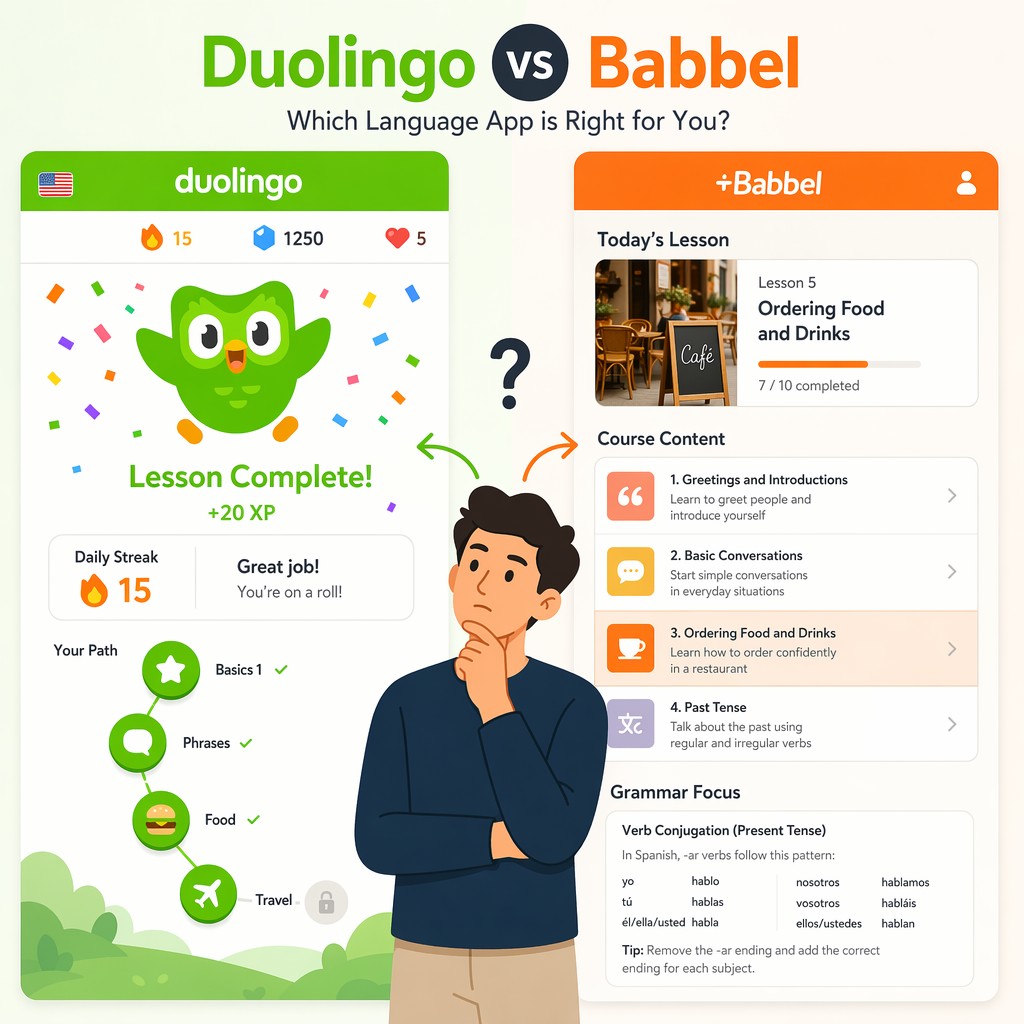
The moment you open Duolingo, you're immersed in a game. The app is colorful, filled with animations, progress bars, and celebratory notifications. Completing a lesson triggers confetti, cheerful sounds, and messages like "You're on fire!" The interface uses bright colors, cartoon characters, and visual rewards to create a sense of fun and accomplishment. Every element is designed to make language learning feel playful rather than like work.
Babbel's interface is noticeably different. It's cleaner, more traditional, and less visually stimulating. The design prioritizes clarity and structure over entertainment. Lessons are presented in a straightforward way: introduction, practice, review. The interface uses muted colors and minimal animations. When you complete a lesson, you get a simple "Lesson Complete" notification without the fanfare. This design choice reflects Babbel's philosophy that learning doesn't need to be gamified to be effective.
Neither approach is objectively better. It depends on how you respond to visual stimulus and game mechanics. If you're easily bored by straightforward instruction, Duolingo's playful interface will keep you engaged. If you find constant notifications and animations distracting, you'll appreciate Babbel's minimalist approach.
Motivation Mechanics and Habit Building
Duolingo is engineered to create daily habits through psychological triggers. Streaks are the primary mechanism. You want to keep your streak alive, so you open the app even on days you don't feel like learning. Push notifications remind you to practice. Leaderboards create social competition. Achievements unlock badges. Together, these mechanics exploit how human brains form habits. Research suggests that Duolingo users do build stronger daily habits than users of other language apps, which is impressive from a behavioral psychology standpoint.
The downside is that habit formation doesn't equal language learning. You might open Duolingo every day to maintain your streak, but that doesn't mean you're making meaningful progress toward fluency. Many Duolingo users report that they feel productive because they're consistent, even though they're not actually learning much.
Babbel takes a different approach to motivation. Instead of external rewards and competition, Babbel motivates through progress tracking. You see your proficiency level increase as you move through the curriculum. You track which skills you've mastered. The motivation comes from measurable advancement toward a goal (fluency) rather than from streaks and leaderboards. This appeals to learners who are intrinsically motivated by progress and achievement.
Accessibility and Ease of Navigation
Both apps are accessible to complete beginners. Duolingo requires zero explanation. You open it, choose a language, and start doing lessons. The interface is intuitive. Almost anyone can figure out how to navigate Duolingo within seconds. This is one reason Duolingo has such a massive user base. The barrier to entry is essentially zero.
Babbel also has a straightforward interface, but it provides more structure upfront. When you start a Babbel course, the app shows you a curriculum roadmap. You can see what lessons are coming, what skills you'll develop, and how the course is organized. This is more helpful for serious learners but slightly more complex for casual explorers.
Readability differs between the apps. Duolingo's lessons use large, simple text and minimal reading. Questions are usually visual or short phrases. Babbel's lessons include more text, more explanation, and more reading. If you have visual fatigue or prefer minimal text, Duolingo is easier on the eyes. If you prefer detailed explanations and don't mind reading, Babbel works well.
Navigation is smooth on both apps. You can move backward and forward through lessons, access your profile, view your progress, and jump to specific topics (especially on Babbel). Neither app feels cluttered or confusing. Duolingo's navigation is slightly more streamlined because the app does less overall. Babbel's navigation is slightly more feature-rich because there's more to access.
The Engagement Question
Here's the reality when comparing Babbel vs Duolingo on user experience: Duolingo wins on short-term engagement and habit formation. Users open Duolingo more consistently and feel more motivated by the gamification. Babbel wins on long-term engagement and sustained learning. Users who stick with Babbel long-term report higher satisfaction because they're actually making progress.
This matters because many Duolingo users quit after a few months or years. The streak eventually breaks, motivation fades, and they realize they haven't actually learned much. Babbel users who commit tend to see real results, which keeps them motivated to continue. The interface isn't as flashy, but the payoff is tangible.
If you're just starting your language learning journey and need something that will get you to open the app daily, Duolingo's interface and engagement mechanics are superior. If you're serious about reaching fluency and willing to trade short-term gamification for long-term results, Babbel's structured, progress-focused approach serves you better.
Speaking, Listening, Reading & Writing Skills
Speaking and Pronunciation: A Critical Gap
This is where many language learners get disappointed with both apps, but especially with Duolingo. Neither app is ideal for developing authentic speaking skills, but they handle it differently.
Duolingo includes speech recognition exercises where you repeat words or sentences aloud, and the app evaluates your pronunciation. The technology works, but it's limited. The app recognizes whether you're saying the right words, but it doesn't provide detailed feedback on accent or intonation. Many users report that the app accepts poor pronunciation as long as it roughly matches the expected audio. You could have a terrible accent and still get credit for the exercise. Additionally, these speaking exercises feel artificial. You're repeating scripted phrases to a machine, not having a conversation with a real person.
Babbel also includes speech recognition, but it's integrated more thoughtfully into lessons. When you practice dialogues with a native speaker on video, you hear authentic pronunciation and can compare your speech to theirs. Babbel's speech recognition provides feedback on whether you pronounced words correctly, but like Duolingo, it doesn't deeply analyze accent or prosody. The key difference is that Babbel embeds speaking practice within realistic scenarios—ordering food at a restaurant, asking for directions, having a conversation—rather than isolated repetition.
In any case, neither app will make you a fluent speaker. Speaking requires real interaction with real people who will correct you, ask follow-up questions, and adapt to your level. Apps can't fully replicate that. Both Duolingo and Babbel acknowledge this limitation, but they handle it differently. Duolingo's approach feels like a game where you score points for pronouncing words correctly. Babbel's approach feels like practice for real conversations you might actually have.
If speaking fluency is your goal, neither app is sufficient. You'll need to supplement with language exchange partners, tutors, or immersion experiences.
Listening Comprehension: Native Speakers vs Synthesized Audio
Both apps use audio throughout their lessons, but the quality and approach differ significantly.
Duolingo uses a mix of synthesized voices and native speaker audio. Many basic lessons feature synthesized speech, which sounds robotic and doesn't reflect natural pronunciation patterns. As you progress to Stories and Podcasts, you encounter native speakers. The native speaker audio is high quality and authentic, but it's inconsistently paced and sometimes difficult to understand if you're a beginner. This creates an awkward progression where early lessons don't prepare you well for understanding real speakers later.
Babbel prioritizes native speaker audio from the beginning. Even in introductory lessons, you hear native speakers, not synthesized voices. This is pedagogically superior. You train your ear to recognize authentic pronunciation from day one. Babbel's native speakers are clear and well-enunciated, making them easier to understand than randomly selected native content. Lessons are designed so you hear new vocabulary spoken clearly before you encounter it in faster, more natural speech.
The listening exercises also differ. Duolingo's listening activities are often simple: you hear a word and select the matching image. Babbel's listening exercises are more varied: you listen to dialogues and answer comprehension questions, listen to new vocabulary in context, or listen to audio and fill in missing words. Babbel's approach better simulates real listening situations.
Reading and Writing Exercises
Duolingo includes reading and writing in most lessons, but the exercises are often simplistic. You might read a short sentence and translate it, or read a dialogue and answer a comprehension question. Writing exercises usually involve typing a translation of an English sentence into your target language. These exercises are fine for vocabulary building, but they don't develop nuanced reading comprehension or natural writing ability.
Babbel's reading and writing exercises are more sophisticated. Reading comprehension activities include longer passages with contextual questions. Writing exercises ask you to compose sentences based on visual prompts or complete dialogues with appropriate responses. Babbel also includes writing prompts that encourage you to think about how you'd naturally express yourself, not just translate English sentence-for-sentence.
The difference matters. Duolingo's approach teaches you to translate. Babbel's approach teaches you to think in the target language. When you translate, you're still anchored to English grammar and sentence structure. When you compose directly in the target language, you develop actual writing ability.
Neither app provides extensive writing practice with feedback from teachers. Both allow you to write, but neither app deeply corrects your writing or explains why your sentence structure is wrong. For serious writing development, you need a human teacher or tutor.
Progress Tracking, Testing & Certification
Duolingo's progress tracking is comprehensive and highly visible. You see your daily streak (consecutive days of practice), your total XP (experience points), your current league ranking, and your proficiency percentage for each language. The app shows you exactly how many lessons you've completed and how far you are through the course. This abundance of metrics creates a satisfying sense of forward momentum. Every completed lesson bumps your numbers up, reinforcing the feeling that you're making progress.
The problem is that these metrics don't necessarily correlate with language ability. You could have a 500-day streak and 50,000 XP but still struggle to hold a basic conversation. The metrics measure app usage, not language proficiency. Duolingo shows you that you've completed lessons, but it doesn't show you whether you've actually retained what you learned or can apply it in real situations.
Babbel's progress tracking is more conservative but arguably more meaningful. You see which lessons you've completed, which skills you've mastered, and your overall proficiency level within the app's curriculum. Babbel also shows you a personalized review schedule, flagging vocabulary and concepts you need to revisit. This approach focuses on demonstrable mastery of specific content rather than abstract metrics.
Babbel's review manager is particularly useful. It identifies areas where you're weak and prioritizes them in your learning path. If you consistently miss words related to food vocabulary, the app will resurface those words more frequently until you master them. This is spaced repetition done right—not just repeating material at intervals, but intelligently targeting your actual weak points.
Formal Assessments and Placement Tests
Here's where the two apps diverge significantly. Duolingo offers the Duolingo English Test (DET), but this is only available for English learners and isn't really a language test—it's a proficiency certification for non-native English speakers applying to universities. For learners studying other languages through Duolingo, there's no formal assessment or certification available. You complete lessons, but you never take a standardized test to verify your level.
Babbel offers placement tests when you start a course. These tests assess your current level and help the app recommend where to begin. More importantly, Babbel provides progress checks at the end of each unit. These are mini-assessments that test whether you've retained what you learned. They're not formal certifications, but they're more rigorous than Duolingo's approach. Babbel also aligns its curriculum with CEFR (Common European Framework of Reference) levels, so you know roughly what proficiency level you should reach by completing each section.
Neither app offers formal certification in the way that traditional language exams do (like DELE for Spanish or DELF for French). You won't get a certificate that employers or universities recognize. This is a significant limitation if you need official proof of language proficiency for professional or academic reasons.
The Proficiency Problem
This is the uncomfortable reality when comparing Babbel vs Duolingo: neither app accurately measures real-world language proficiency. Both apps can tell you what you've completed within their system, but they can't tell you whether you can actually function in the language.
Here's a concrete example: Duolingo might show that you've completed the entire Spanish course and reached a "Duolingo Score" of 129. What does that mean in real terms? Can you order food in Spanish? Have a basic conversation? Read a newspaper article? Understand a movie? Duolingo's proficiency metric doesn't answer these questions. It only tells you that you've completed lessons and achieved a certain score.
Babbel's approach is slightly better because it aligns with CEFR levels. If you complete Babbel's Spanish A1 unit, you theoretically have A1-level proficiency (beginner). If you complete A2, you have A2 proficiency (elementary). This is more meaningful because CEFR is an internationally recognized framework. However, even this has limitations. Completing a Babbel unit doesn't guarantee that you can actually function at that level. It means you've learned the content covered in that unit.
Real-World Outcomes: The Gap Between App Proficiency and Actual Ability
This is where both apps have a credibility problem. Many users report that after completing a Duolingo course or significant portion of a Babbel course, they struggle to understand native speakers or hold conversations beyond scripted scenarios. Why? Because app learning and real-world language use are fundamentally different.
Apps teach vocabulary and grammar in controlled contexts. Real language is messy, fast, and filled with slang, accents, cultural references, and unexpected questions. Apps let you take your time reading and responding. Real conversations require quick thinking and spontaneous speech. Apps present vocabulary in isolation or in simple sentences. Real content features complex structures and nuanced meanings.
Neither app is transparent about this gap. Duolingo's metrics might suggest you're at "intermediate" level when you actually can't follow a Spanish news broadcast. Babbel's CEFR alignment is more honest, but even Babbel users sometimes overestimate their abilities based on app performance.
Testing and Real Validation
If you want to know your actual language proficiency, you need external validation. Take a standardized test like DELE (Spanish), DELF (French), or equivalent exams for your target language. These tests assess real skills: reading comprehension of authentic materials, listening to native speakers at natural pace, written expression, and spoken interaction.
Both Duolingo and Babbel can prepare you for these tests, but neither app will definitively tell you whether you're ready. You could complete Babbel's curriculum and be B1 level on the CEFR scale according to the app, but still fail an official B1 exam because the test measures authentic skills rather than app-specific knowledge.
Pricing & Value
Duolingo's Freemium Model
Duolingo's pricing strategy is designed to be accessible. The free version includes all the core features: lessons, streaks, leaderboards, and Stories. You can learn indefinitely without paying a cent. The trade-off is ads. Duolingo's free version displays advertisements between lessons and throughout the app experience.
Super Duolingo (formerly Duolingo Plus) costs $12.99 per month or $83.99 per year. For this subscription, you get ad-free learning, unlimited energy (the free version limits mistakes), and personalized practice.
Duolingo Max is Duolingo's highest tier at $29.99 per month or $168.99 per year. Max includes everything Super offers, real-world interactive conversations with Duolingo characters, on-demand conversations with the popular Duolingo character, Lily, and detailed personalized breakdowns of why your answers are correct or incorrect. Max is Duolingo's recent attempt to justify a higher price point, but most serious learners find Super Duolingo sufficient. The AI explanations are helpful but not transformative.
Babbel's Subscription Model
Babbel doesn't offer a free tier. Every user must subscribe. However, Babbel's pricing is structured around commitment length. A monthly subscription costs around $17.95 to $8.95 per month. A 3-month subscription costs approximately $15.25 per month (roughly $45 total). A 6-month subscription costs around $13 per month (roughly $80 total). A 12-month subscription is typically $8.99 per month (around $107 year).
Babbel frequently runs promotional offers, especially for new users. First-time subscribers often see discounts of 50% or more on their first three months. A new user might pay $2-3 per month for the first three months, then transition to regular pricing. This aggressive introductory pricing is Babbel's way of getting users invested.
Babbel offers a 20-day money-back guarantee. If you're not satisfied after 20 days, you get a full refund. This is consumer-friendly, though it means Babbel is confident that users will experience enough value in three weeks to keep them subscribed.
The Hidden Value Proposition
Here's where things get nuanced. Duolingo's true value proposition isn't just the app—it's the community. Duolingo has millions of users. You can compete on leaderboards, share your progress, and congratulate others in their in-app feed. This social element has real value for some learners.
Babbel's true value proposition is efficiency. You're not paying for an entertainment experience. You're paying for a system designed to get you to proficiency as quickly and systematically as possible. If your time is valuable, Babbel's structured approach might be worth more per dollar than Duolingo's broader but shallower offering.
Real-World Cost of Language Learning
Neither app is free after you account for your time and the reality that apps alone won't make you fluent. If you're serious about reaching B2 level (upper intermediate) or higher, you'll eventually need:
- Tutoring or conversation partners ($10-30 per hour)
- Authentic content subscriptions (Netflix, YouTube, podcasts—often free but time-intensive)
- Possibly in-person classes or immersion experiences (hundreds to thousands of dollars)
When you factor in these realistic costs, the $72-84 annual subscription to either app becomes a minor expense. The real cost is your time and the supplementary resources you'll need.
Money-Back Guarantees and Risk
Duolingo doesn't offer a formal money-back guarantee, but the free tier means you can try it indefinitely without risk. If you subscribe to Plus or Max, you're taking a small financial risk, but at $12.99/month, the risk is minimal.
Babbel's 20-day money-back guarantee is more consumer-friendly. You can try Babbel fully, and if you don't like it, you get your money back. This reduces the financial risk of commitment. The downside is that 20 days isn't much time to evaluate a language learning app. Most people need 2-3 months to really assess whether an app works for them.

0 comments