Unlock Your Polyglot Potential — Without Wasting Time on Random Apps
In just 7 days, set up your personalized language learning system and start making real progress with The Aspiring Polyglot's Toolkit.

Dear Friend,
If you want to learn 2–3 languages at once without the overwhelm...
Then this page will show you a simple, plug‑and‑play toolkit that combines the exact apps you need and how to use them together for real progress...
All this without sifting through dozens of tools, second‑guessing your plan, or burning out.
CAN YOU RELATE?
You want to track your progress, build speaking confidence, and finally see a path to becoming a polyglot.
You’re looking for a clear, step‑by‑step toolkit that tells you exactly which apps to use together, in what order, and for how long.
You’ve bounced between Duolingo, YouTube, and random apps… yet you still feel stuck, overwhelmed, and unsure what actually works.
You spent years in school “learning” a language, but still can’t hold a real conversation, and you’re tired of starting over.
You want a simple daily routine (20–60 minutes per language) that shows measurable progress within a few weeks.
Using the right blend of apps and tools is the fastest path for busy English-speaking adults to enjoy learning multiple languages at the same time.
Most people don’t fail because languages are “too hard.” They fail because the process is chaotic. App‑hopping. Random tips. No plan. A smart combination of tools removes the guesswork: one app for input (watching/listening), one for vocabulary (spaced repetition), one for speaking practice, one for tracking.
Each tool does what it’s best at and together they make progress simple, measurable, and fun.
And if you want to learn multiple languages and actually enjoy it, then you need to solve the overwhelm of “what should I use and when?” and use a focused tool stack to its fullest potential so every minute of study has a job.
How long will you keep bouncing between random apps and grammar drills that never stick?
How many times will you restart Spanish next January only to quit by February?
Don’t you deserve a plan that respects your time, your heritage, and your goals?
There’s a better way…
Imagine building momentum in 2-3 languages at once, without mixing them up or spending all day studying.
Picture yourself understanding a podcast on your commute and then nailing those words later because your system prompts you at the right time.
Envision speaking with family in their language and realizing you actually enjoyed the process that got you there.
Imagine watching a video in a language other than your native tongue and catching all the subtleties without missing a beat.
Why this approach wins.
It’s faster because each tool does one job exceptionally well (no bloated “all‑in‑one” promises). It’s easier because you follow a clear routine (20–60 minutes per language) instead of guessing.
It lasts longer because spaced repetition and regular input lock words and structures into long‑term memory so you keep what you learn.
According to research, spaced repetition significantly boosts long‑term retention (Psychological Science, Cepeda et al.), retrieval practice is among the most effective learning strategies (Review of Educational Research, Dunlosky et al.), and too many choices drain willpower and follow‑through (decision fatigue research from the APA/Baumeister).
Linguists have also shown that consistent, comprehensible input accelerates acquisition, especially for adults.
“But isn’t learning multiple languages at once confusing?”
It can be, if you wing it. With a clear routine, distinct contexts, and the right tool roles, cross‑language interference drops and progress compounds.
“But I’m 30+. Isn’t it too late?”
Not at all. Adults excel at self‑directed learning, pattern recognition, and habit formation. With the right system, you’ll progress faster than you think.
Right now is the best time to lean in: the tools are better, cheaper, and smarter than ever.
Authentic content is everywhere; and your motivation is fresh. Wait, and you’ll slip back into research mode: more options, more noise, less action.
Start small today, lock in your routine, and let the compounding do the heavy lifting.
Here are some of the most common problems people go through
Problems
- I have no clear system: every app promises the world, I don’t know which ones to use for what, or how they fit together.
- I’m worried I’ll mix my languages and get overwhelmed because I don’t have a simple way to keep them separate day to day.
- I can’t stick to a consistent routine—I sit down and don’t know exactly what to do first, for how long, or in which language.
- I don’t have a clean way to track progress across languages, so I can’t tell if what I’m doing is working.
- School-style studying burned me out. Grammar drills and random vocab lists don’t stick, and I still freeze when it’s time to speak.
Wrong solutions
- Trying to do everything inside one app (Duolingo will somehow handle listening, vocab, speaking, and tracking… right?).
- Downloading 10 apps and hopping between them with no roles or plan, just chasing whatever feels new.
- Binging YouTube “polyglot hacks” and copy‑pasting someone else’s routine without adapting it to my life as an English speaker.
- Grinding grammar textbooks and 5,000‑word lists before touching real content.
- Paying for tutors in multiple languages without a daily system. You might learn a lot during the lessons but there's zero momentum between sessions.
First, let me be very clear.
I can’t guarantee you’ll get the same results.
I’ve spent around 2 years and over 3,000 hours refining how to learn 2–3 languages at once as a busy adult.
But would getting even a fraction of that momentum still be interesting to you?
If yes, read on…
Because what I’m going to share with you is simple.
It shows native English speakers exactly which apps to use together, and how, to learn multiple languages simultaneously without overwhelm.
What do I mean by fast?
In the next 48 hours, you could have your toolkit installed, your routine mapped, and your first study blocks done, so you’re actually moving, not just researching.
Before I show you how it works, a quick warning:
This isn’t magic. It still takes a bit of thinking and a few focused minutes a day.
If you’re hunting for a single app that “does it all” while you sleep, this won’t help.
But it does have some big advantages
It’s affordable: no need to drop thousands on tutors or bloated courses you won’t finish.
It’s simple: a paint‑by‑numbers stack where each app has one job—input, vocabulary, speaking, tracking.
It’s fast to start: you can run this in 20–60 minutes per language a day, even with a full‑time job and family.
Now, you might be wondering how this is possible…
Start by feeding your ears and eyes. This is the base. If you miss this, everything feels hard. The idea is simple: listen to short, easy stuff and read along at the same time. Use an app that shows the text, lets you tap words, and slows the audio.
Think of it like watering a garden. Little sips, every day.
Here’s why it works: your brain spots patterns when it sees words and sounds in real stories, not just in lists. You learn “how it sounds” and “what it means” together.
How it works: pick a 3–5 minute clip or story at your level. First, listen once. Then listen with text. Tap words you don’t know. There are apps that allow you to do this. Read it out loud. Done.
In one hour, do 2 or 3 of these. If you start this today, by the end of week 1, you’ll catch common words without trying.
After a few weeks, whole lines will click. You will stop freezing when you hear fast speech, because your brain has heard it many times in a safe way.
Next, lock in the words so they stick. Pay attention here, because forgetting is normal, and this fixes it. The idea: make tiny flashcards from the words and phrases you just saw in your reading and listening.
Use an app that shows the card right before you forget it. Think of it like a smart coach who taps your shoulder at the perfect time.
Why it works: short, spaced reviews move words from “I’ve seen it” to “I can say it.” You practice pulling the word from your memory, not just seeing it.
How it works: add 10–20 cards a day from your input. Keep them short. Add audio. Tag each language with its own color.
Do one 10–15 minute review in your hour.
If you start this today, in 30 days you can know 300–600 real words and chunks that you actually use. You’ll mix up languages less, because each set has its own color and sounds.
Now, train your mouth. This part matters, because reading alone won’t make you speak.
The idea: copy clear sentences out loud, record yourself, and get quick feedback from a tutor or native speaker if available. It’s like tracing a picture before you draw freehand.
Why it works: your tongue learns shapes by doing. When you shadow (repeat with the audio), you learn rhythm. When you record and compare, you spot what to fix.
How it works: choose 5–10 lines from the story you just studied. Listen once. Repeat with the speaker. Then pause and repeat on your own. Record. End with one tiny prompt, like “Order coffee” or “Introduce yourself,” using the same words from today.
Spend 15–20 minutes of your hour here. If you start this today, in two weeks you will say full lines without thinking. In a month, you can handle short chats. You will feel less shy, because you practiced in private first.
Keep score and set guard rails. This keeps you going on busy days. The idea: use a simple tracker and timer so you always know what to do, for how long, and when you are done.
Give each language its own time, color, and space. It’s like laying train tracks so the trains don’t crash.
Why it works: a plan removes guesswork. A timer cuts drift. A streak makes you want to show up. Different colors and set times stop your languages from blending.
How it works: pick your slots (for example, Spanish at 7:30 am, Japanese at 8:00 pm). In each hour do 25 minutes input, 15 minutes cards, 20 minutes speaking and/or writing. Tap “done” in your tracker. Write one win a day (“understood a joke,” “said a full order”). Review your week every Sunday and adjust.
If you start this today, you’ll feel calm and clear by day three. In a month, you’ll see real gains on your chart and hear them in your voice. No more app hopping. Just steady steps that add up.
This is why I created “The Aspiring Polyglot’s Toolkit”.
This is a set of tools and apps that work harmoniously together to help you tackle multiple languages at once without feeling overwhelmed.
The Aspiring Polyglot's Toolkit
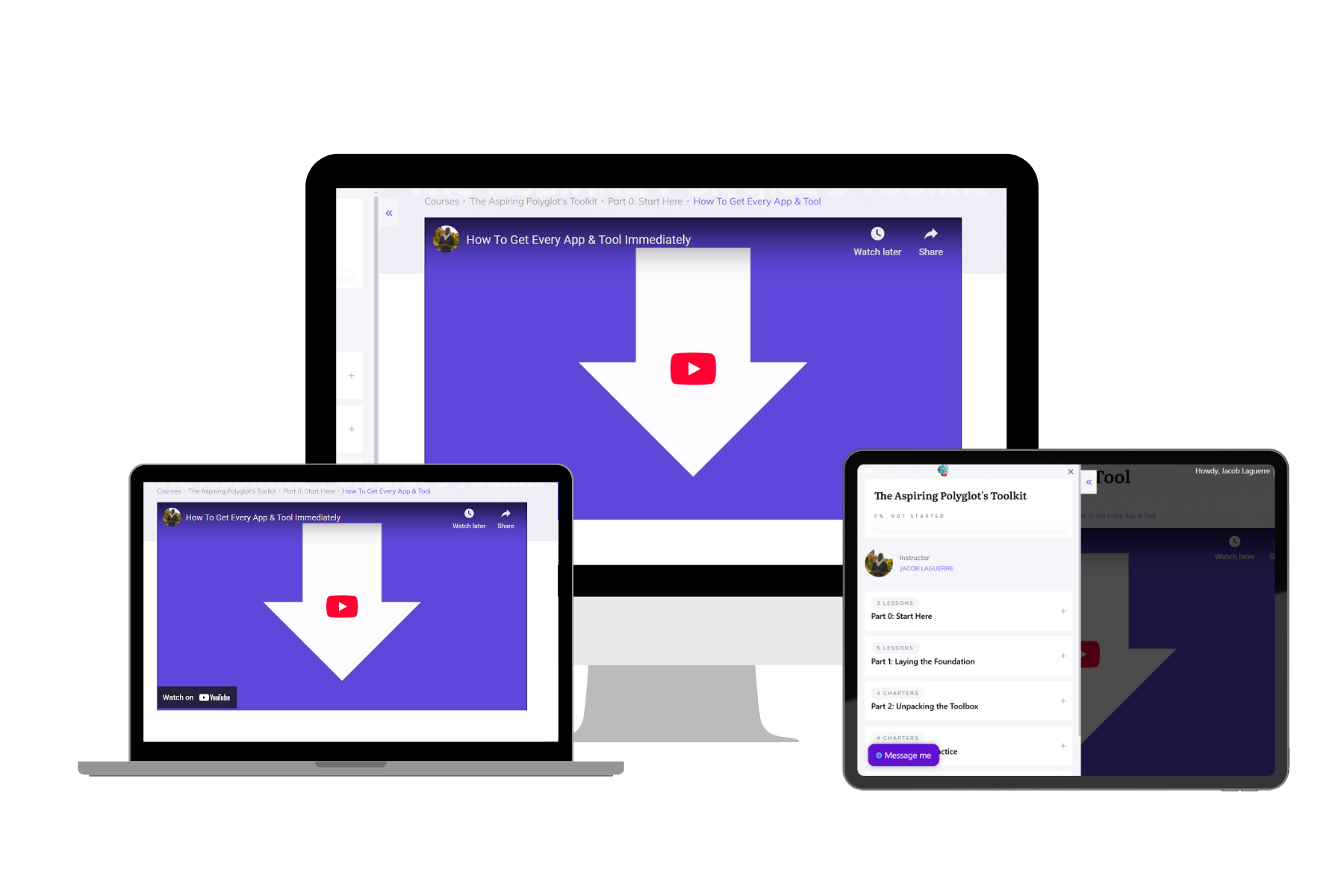
The Aspiring Polyglot’s Toolkit is a curated collection of apps and tools to help you learn your target language. While there are many outstanding resources available, none of them are sufficient to work on their own. However, using the right tools that are good at particular things is the key to achieving language learning success.
About Jacob Laguerre
Jacob Laguerre is an Esperantist, aspiring polyglot, and business owner. After struggling with languaeg learning for years, he came across a method that enabled him to go from hopeless monolingual to "giga chad" multilingual. His goal now is t help native-level monolingual English speakers learn languages in a way that's fun and allows you to make consistent progress regularly.
Course Modules
Here's what you get in the toolkit
Bonus
When you join today, you'll get access to an exclusive set of bonuses to take your language learning to the next level.
While the core content contains everything you need for your language learning success, if you join today, I’ll throw in a set of bonuses that will help to accelerate your results even faster.
Course Bonuses
Join today and get 5 additional bonuses to go with your toolkit!
Bonus #1: Tiny Wins Cheat Sheet
We all have those days where it seems like getting in some language learning is next to impossible. Using this handy cheat sheet, you’ll get access to 10 “tiny wins” to ensure you don’t let a day go by without doing any language learning.
Bonus #2: CI Resources
I’ll share a link with you to a free resource that’s a treasure trove of Comprehensible Input videos in dozens of languages. Use comprehensible input to build your comprehension and start engaging with your TL from day one!
Bonus #3: Honorable App Mentions
While not part of the core set of apps and tools I recommend, there are a couple of other language learning apps that you may find useful in your language learning journey. One of them is completely free and teaches you over 1,000 words in 21 languages through a series of 5 interactive games.
Bonus #4: Interactive Immersion Tutorial
Interactive Immersion is a key activity when it comes to immersing in content in your target language. This is what allows you to expand your abilities in your target language and train your ear to parse the language. In this video, I’ll show you 4 ways you can practice interactive immersion in your target language.
Bonus #5: Language Learning Quickstart Bundle
Inside this bonus, you'll receive three curated, done-for-you resource guides for specific languages I highly recommend. Each one bypasses the typical "what do I use?" research phase by delivering a complete list of additional, high-quality, and often-free tools, community resources, and content tailored to that language. This means you can skip straight to high-impact practice and gain an immediate, unfair advantage in launching your first (or next) three languages.
4 reasons why this course will pay for itself at least 10 times…
1
Tutors without a plan = expensive trial and error
A good tutor is about 20–40/hour. One hour a week per language is 80–160/month… per language. So two languages and you’re at 160–320/month. Without a clear system, 30–50% of each lesson gets spent deciding what to review, which app to use, and what homework to do. That’s $48–160 of waste every month. For $27, you get a working plan first. Then your paid lessons become practice, not planning.
2
Big-name courses and app bundles = pay per language, not for a system
Flagship courses run $199–$999 per level, sometimes per language. Even “cheap” subscriptions add up: $12–$30/month per app. Two or three apps across a year is $288–$1,080, and you still don’t know how to fit them together. You’re buying content, not a process. The $27 toolkit gives you a simple stack and sequence so the tools you already have do the right job in the right order.
3
DIY research and app-hopping = sunk time that never comes back
Most people burn invaluable time comparing apps, watching reviews, and rebuilding trackers. The toolkit cuts the guesswork on day one, so your first 60 minutes produce progress, not more tabs.
4
The cost of inaction = compounding loss (money, time, motivation)
Wait six months and you’ll likely keep two unused subs at ~$12each ($144/year), re-learn the same basics for the third time (~30 hours), and miss another season to speak with family or use the language on a trip. Decision fatigue grows and motivation drops. Every restart costs more than the $27 you’re saving. Start once, stick to a one-hour plan, and let the compounding work in your favor.
Join Today!
the aspiring polyglot's toolkit
$
47
100% Satisfaction-Guarantee.
If, for any reason, you feel like this toolkit wasn't worth your time or money, you can get a full refund anytime within 30 days after your purchase. If you have any issues, just shoot me an email and I'll either help you out until you get the results you need or give you a swift refund.
faq
You can speak as soon as you want, but I recommend waiting a bit before trying to speak.
They definitely help but they’re not necessary. If you have a couple of dollars to spend, I'll show you where to find the best ones on the internet.
Missing a day is ok but try not to miss 2 in a row. We’re including a special bonus that will give you a set of quick wins you can do to ensure you do at least a little bit of language learning and never end the day doing nothing.
Ultimately, yes, but it doesn’t have to be your main focus.
Ultimately, yes, but it doesn’t have to be your main focus.
Yes, many of the tools and apps we share have a free plan or a low-cost paid plan.
Very few people are actually bad at learning languages. The fact that you learned your native language is proof that you’re capable of learning. All you need is the right apps and tools and how to put them together and you’ll be off to the races.
Yes. Setup for most of the apps are pretty straightforward.
Start your language learning journey today!
The path to polyglotism awaits you.
Personal Note
Language learning can be quite challenging but extremely rewarding. I know what it’s like to be spinning your wheels and getting nowhere fast. I’ve tried many of the most popular apps and always felt like something was missing. Turns out, no single app is going to give you everything you need. But the right combination of apps will. That’s why I put this toolkit together so you don’t have to do any of the guesswork. You can simply learn and apply and before you know it, you’ll be speaking multiple languages in no time. I’ll see you on the inside.
